Your NDIS plan review can feel like a big moment – and it’s completely normal to feel a little anxious before it. Will you get the funding you need? Have you gathered the right information? What if you forget to mention something important?
Take a breath. A plan review isn’t a test, and it isn’t something to dread. Think of it as a check-in: a chance to look back at what’s been working, be honest about what hasn’t, and shape a plan that fits the life you’re actually living. And the good news is that a little preparation goes a long way.
In this blog, we’ll walk you through a simple, practical checklist so you can head into your next review feeling calm, organised, and confident.
Quick Answer
To prepare for your NDIS plan review (plan reassessment), gather your current plan, review how your funding was used, collect recent therapist reports, update your goals, note any changes in your circumstances, explain any unspent funding, and bring someone you trust if you’d like support during the meeting. Starting around one month before your reassessment gives you enough time to organise your evidence.
First, a quick note on names
You might hear your review called a few different things. Officially, the NDIS now calls it a plan reassessment, though many people (and plenty of providers) still call it a “plan review”. They mean the same thing – a scheduled look at your plan before it ends, to decide what your next plan should include.
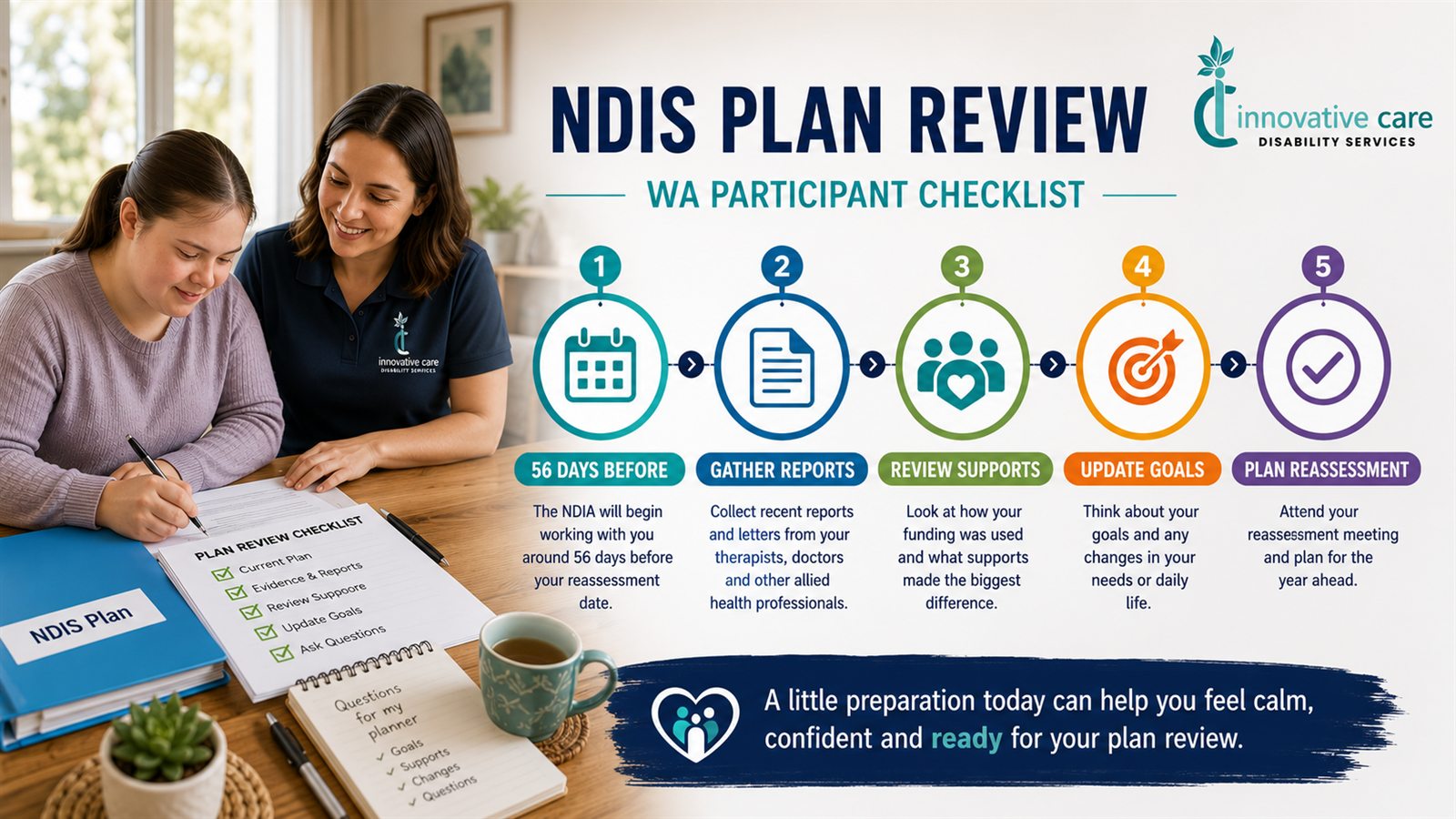
When your plan is around 56 days from its reassessment date, the NDIA will generally begin working with you to prepare your next plan. Treat this as your cue to make sure your reports, notes, goals, and other evidence are ready. Your reassessment meeting can be held face-to-face, over the phone, or by video call – whichever suits you best.
Your NDIS plan review checklist
Here’s everything worth sorting before your meeting. Work through it at your own pace – you don’t have to do it all in one sitting.
1. Dig out your current plan
Find a copy of your current NDIS plan and read back over it. Remind yourself of the goals you set last time and the supports you were funded for. This is your starting point for the whole conversation.
- What goals did you set?
- Which supports were funded, and in which categories (Core Supports, Capacity Building, Capital Supports)?
- When does your plan end?
2. Review how your funding was used
Before your meeting, take a look at your spending during your current plan. You may be able to access this information through your Plan Manager, the my NDIS participant portal or app, or the myplace portal if your plan is still on the older system.
- Which supports did you use the most?
- Was any funding left unspent – and if so, why?
- Did your spending match your goals, or did your needs shift along the way?
If you have leftover funding, don’t panic. Just be ready to explain it. A provider may have cancelled, a waiting list may have held things up, or supports may simply have been hard to access – which happens a lot in regional and remote parts of WA. Explaining the gap clearly helps the NDIA understand why the funding was not used and whether similar supports may still be needed in your next plan.
If you’re not sure how your supports are being paid for or coordinated, it’s worth understanding the difference between plan management and support coordination, so you can choose the setup that suits you best.
3. Note any changes in your circumstances and daily function
Planners want to understand how your day-to-day life has changed since your last plan. This is often the most important part of the conversation, so give it some real thought.
- Has your mobility changed?
- Has communication become harder?
- Have everyday tasks – cooking, showering, getting around – become easier or more difficult?
- Have your informal supports changed (for example, a family carer moving away or becoming unwell)?
- Has your health, housing, work, or study situation shifted?
Write down anything that’s different. These are exactly the things planners ask about, and being ready to describe them clearly makes a real difference.
4. Reflect on what worked (and what didn’t)
This is the heart of the review. Give yourself a little time to think honestly about the past year.
- What worked well? Which supports made a real difference?
- What goals did you achieve?
- What didn’t go to plan, and why?
- Is there anything you’d like to do differently next year?
Jot your thoughts down. It’s far easier to speak clearly in the meeting when you’ve already put the words on paper.
5. Gather your evidence
Evidence is what turns “I feel like I need this” into a clear case the NDIA can act on. Aim to have this ready at least a month before your reassessment date.
- Recent reports or assessments from your therapists, doctors, or allied health professionals
- Updates from your support workers on the supports they’ve delivered
- Any letters or recommendations pointing to supports you’ll need in the year ahead
Here’s why this matters so much: the NDIA makes decisions based on evidence showing how your disability affects your daily life, and how your recommended supports will help you work towards your goals. Reports that describe functional impacts and expected outcomes – what you can and can’t do, and how a support will help – are usually far more useful than a document that simply confirms a diagnosis. When you ask a therapist or provider for a report, it’s worth asking them to focus on exactly that.
If any of the supports relate to a young child, the evidence required may look a little different. Innovative Care can help families understand what information may be useful to discuss with their NDIS contact and treating professionals.
6. Set your goals for next year
Your next plan is built around your goals, so it’s worth thinking about them ahead of time. They don’t have to be dramatic – small, meaningful goals count. If you’re not sure where to start, here are some examples participants often use:
- Build confidence travelling independently
- Improve cooking and daily living skills
- Join more community or social activities
- Increase work or study readiness
- Improve communication
Be ready to explain how each requested support relates to your disability support needs, helps you pursue your goals, and meets the NDIS funding criteria. Connecting your supports to your goals is a good start, but the NDIA looks at the full “reasonable and necessary” criteria, not goals alone.
7. Think about how you want your funding managed
Your review is also a chance to change how your plan is managed – whether that’s self-managed, plan-managed, or NDIA-managed. If your current setup has felt like too much admin, or not flexible enough, say so. It also helps to be across the current NDIS price limits before you renew any service agreements, so the rates in your agreement stay within the official caps.
8. Decide who you’d like with you
You don’t have to walk into your review alone. You’re welcome to bring someone who knows you well and can help you feel at ease.
- A family member, carer, or friend
- Your support coordinator, if you have one
- A support worker who understands your day-to-day needs
Your printable pre-review checklist
Print this out and tick each item off as you go:
- Copy of your current NDIS plan
- Funding / spending report for your current plan
- Recent therapist and allied health reports
- GP or specialist letters
- Notes on any changes to your circumstances or daily function
- Your goals for the year ahead
- Questions you want to ask the planner
- A support person to join you (if you’d like one)
What happens after the meeting
After your reassessment meeting, the NDIA will consider your current plan, how you have used your supports, the evidence you provided, and the goals and support needs discussed with you. The time taken to approve your next plan can vary, so ask your NDIS contact what timeframe applies to your reassessment.
Once a decision is made, check your new plan carefully. Make sure you understand the funding included, how it is managed, and when the plan is due to be reassessed again.
A heads-up on changes coming to NDIS planning
The NDIA is preparing for a phased rollout of a new way of planning from the middle of 2026. This will include support needs assessments designed to help determine participants’ disability support needs and create more flexible budgets. Because the approach is being introduced gradually, not every participant will move to the new process at the same time. You don’t need to be across every detail, but it’s worth knowing the process may look a little different at your next review. If anything’s unclear, your provider or plan manager can help you make sense of it.
Frequently asked questions
When should I start preparing for my NDIS plan review?
Start gathering your information at least one month beforehand. The NDIA generally begins working with participants when their plan is around 56 days from its reassessment date, so preparing early can help you avoid a last-minute rush.
What evidence should I bring?
Recent therapy reports, GP letters, specialist assessments, and support worker progress notes – ideally ones that describe how your disability affects your daily life and recommend supports linked to your goals.
Can I bring someone to my review?
Yes. Many participants choose to bring a family member, friend, support coordinator, or support worker who knows them well and can help during the meeting.
What happens if my circumstances have changed?
Tell the NDIA during your reassessment and provide evidence where you can, so your next plan reflects your current support needs. Changes to your health, mobility, communication, living situation, or informal supports are all worth raising.
Need help getting review-ready?
We know a plan review can feel like a lot to hold in your head – the paperwork, the reports, the “have I forgotten something?” worry. Please don’t carry it on your own. As a local, NDIS-registered provider based right here in Western Australia, the Innovative Care team helps participants across Perth and WA get review-ready every day.
Innovative Care can help you organise your reports, understand your current supports, prepare for your reassessment meeting, and make sure your goals are clearly documented before your review. Email us at info@innovativecarewa.com.au or call 08 6202 0120 – we’re always happy to help.