Most NDIS applications in WA don’t fail because people aren’t eligible.
They fail because the evidence isn’t strong enough — and by the time applicants realise that, they’ve already lost months waiting for a decision.
For many people, this isn’t just paperwork. It’s access to the support they need to live independently, communicate, or simply get through the day.
If you’re in Western Australia and working out how to apply for the NDIS in WA, this guide covers every step: what to prepare, what the NDIA is actually looking for, and how to avoid the mistakes that delay or derail applications.
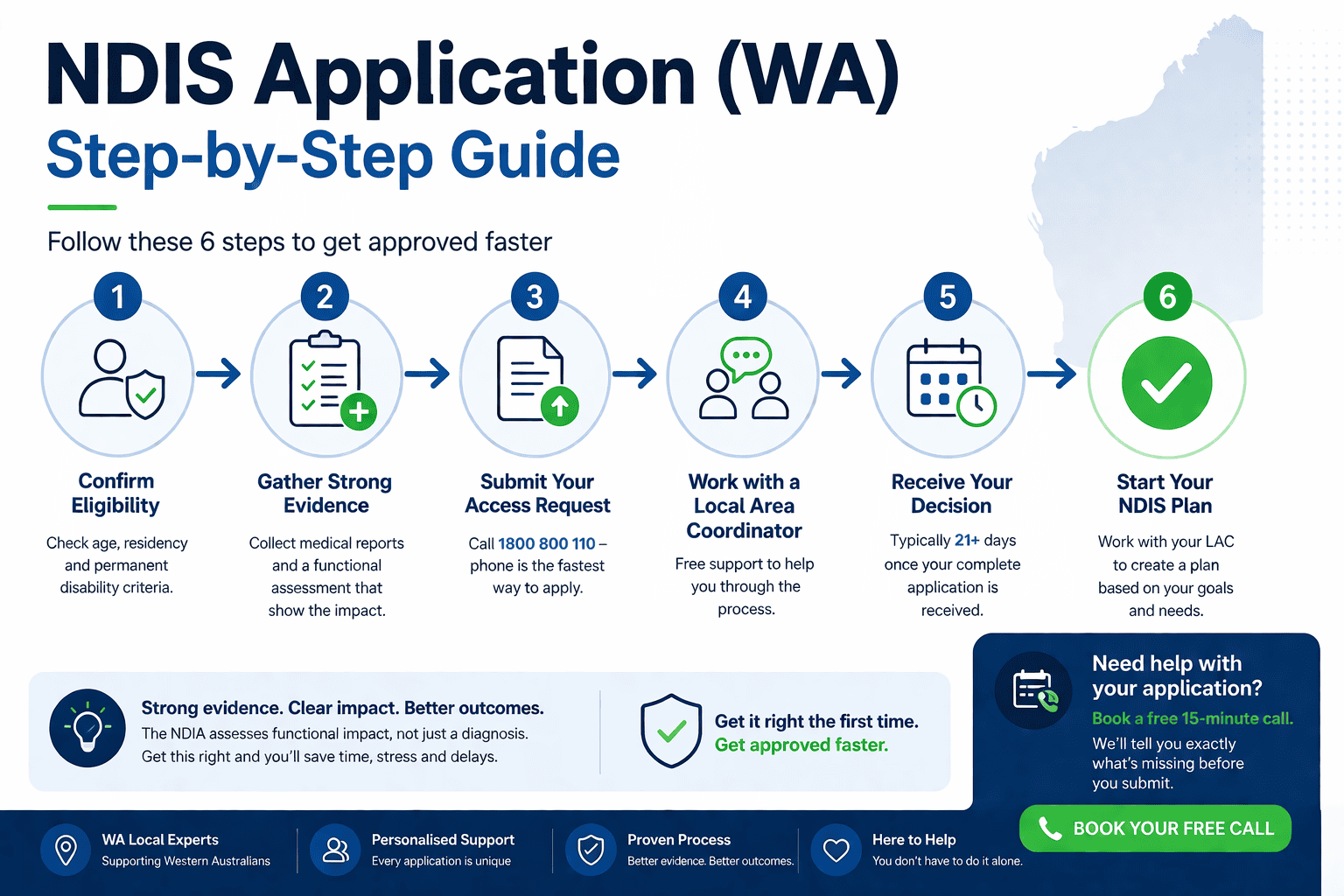
Quick Summary: How to Apply for the NDIS in WA
- Confirm eligibility — under 65, permanent disability, Australian resident
- Gather strong evidence — medical records and a functional assessment
- Submit your Access Request — phone (1800 800 110) is fastest
- Work with a Local Area Coordinator — free, and available before you apply
- Receive your eligibility decision — typically 21+ days once complete
- Start your NDIS plan — with your LAC, based on your goals and needs
Step 1: Confirm You Meet the NDIS Eligibility Criteria
Before gathering a single document, confirm you qualify. The NDIA checks three things: you must be younger than 65 on the day you apply, you must meet the residence requirements, and you must have a permanent impairment that substantially reduces your functional capacity, or an early intervention need.
Eligibility is assessed on functional impact, not diagnosis alone, which is why two people with the same condition can get very different outcomes. Our NDIS eligibility criteria and checklist for WA works through every test in detail and includes a printable checklist you can take to your GP.
WA-specific note: If you were previously supported through the former Disability Services Commission (now part of the Department of Communities), you may have already been transitioned to the NDIS. Check before starting a new application to avoid duplication.
⚠️ Before You Gather Evidence: Read This First
If your supporting documents do not clearly demonstrate all three of the following, your application is likely to be delayed — or rejected — even if you are genuinely eligible:
- Permanence — the disability is lifelong or long-term
- Functional impact — it substantially limits daily activities
- Need for funded support — informal care alone is not enough
This is not a paperwork technicality. It is the framework the NDIA uses to make decisions. The steps below show you exactly how to build a submission that addresses all three.
Step 2: Gather Your Evidence — Where Applications Succeed or Fail
Weak evidence is the single most common reason NDIS applications in WA are rejected or delayed.
Mistakes here can push your approval back by months. Get this right and the rest of the process moves significantly faster.
What the NDIA Is Actually Looking For
The NDIA is not assessing your diagnosis. According to NDIA guidelines, it is assessing three things from your evidence:
- Permanence — Is the disability lifelong, or is it likely to remain long-term?
- Functional impact — How does the condition affect mobility, communication, self-care, social participation, and learning — and what can’t the person do as a result?
- Need for funded support — Is informal support from family or community insufficient to meet your needs?
Every document you submit should speak to at least one of these. A diagnosis letter that doesn’t address daily function is not sufficient on its own.
The Two Types of Evidence You Need
Medical evidence (establishes permanence):
- Reports from your GP, specialist, psychiatrist, or paediatrician
- Diagnosis letters and clinical notes
- Hospital discharge summaries
Functional evidence (establishes impact on daily life):
- Occupational Therapy (OT) assessment — the single most valuable document in most applications
- Reports from speech therapists, physiotherapists, or psychologists
- School reports or assessments for children
How to Strengthen Your Evidence
Ask your GP to use the NDIA’s Supporting Evidence form — it’s structured around what the NDIA needs and removes ambiguity.
Ask all treating professionals to describe the disability as permanent and to explicitly describe the impact on everyday activities — not just the existence of a condition.
OT functional assessments are weighted heavily because they directly map a person’s condition to the tasks the NDIA assesses. If budget allows, prioritise this above all else.
For psychosocial disability (e.g. mental health conditions), a psychiatrist report combined with an OT functional assessment is a consistently strong combination.
Evidence should ideally be within the last 12 months, though older reports are sometimes accepted with supporting context.
Perth tip: GPs in suburbs like Balga, Armadale, Morley, and Mandurah often have experience completing NDIS supporting evidence. Ask directly: “Have you completed NDIS supporting evidence before?” An experienced GP knows the framing the NDIA responds to. If yours doesn’t, ask for a referral to an allied health provider who does.
Report gathering typically takes 2–6 weeks. Start booking appointments now — even before you’re ready to submit — or this stage alone can push your entire timeline out significantly.
If you get Step 2 right, you dramatically increase your chances of fast approval. Every other step follows from the strength of what you submit here.
Not sure if your evidence is strong enough before you submit?
We review NDIS application evidence for WA participants and can tell you exactly what’s missing — before it reaches the NDIA.
→ Book a free 15-minute evidence review
Real Example: WA Application Approved in 4 Weeks
A Perth applicant in their early 30s with a psychosocial disability submitted:
- A GP report confirming permanence and diagnosis
- A psychiatrist report detailing clinical history and functional limitations
- An OT functional assessment mapping daily task limitations specifically
Outcome: Approved in approximately 4 weeks. Support coordination was included in the first plan.
Key factor: The OT report explicitly connected the applicant’s condition to daily living tasks the NDIA assesses — communication, self-care, and community participation. The NDIA had everything it needed to decide without requesting further information.
Step 3: Submit Your Access Request Form
Once your evidence is ready, formally apply by submitting an Access Request Form (ARF).
Option 1: Phone (fastest)
Call 1800 800 110, Monday to Friday, 8am–8pm. An NDIA representative completes the form with you. This is the fastest submission method by a significant margin.
Option 2: Online
Complete the form at ndis.gov.au via your myGov account linked to the NDIS portal.
Option 3: In person or by post
Download the form from the NDIS website and lodge it at your nearest NDIA office or through a Local Area Coordinator. LACs operate across all Perth metro regions and many regional WA centres.
The form covers your personal details, disability information, how it affects your daily activities, and your treating professional’s contact details. You can attach evidence directly or have providers send it separately — confirm this is happening so nothing is missed.
Step 4: Work With a Local Area Coordinator (LAC)
If you’re new to the NDIS, your LAC is your most important free resource throughout this process.
LACs are funded by the NDIA and delivered by community organisations — in WA this includes providers such as Nulsen Group, Rocky Bay, and Intereach, depending on your region.
Your LAC will:
- Help complete your Access Request if needed
- Liaise with the NDIA during the eligibility assessment
- Once approved, help build your first NDIS Plan based on your goals
- Connect you with local providers in your area
Find your LAC by calling 1800 800 110 or searching by postcode at ndis.gov.au. Reach out early — before your application is finalised, not after.
Step 5: Wait for the Eligibility Decision
After submission, the NDIA has 21 days to make an eligibility decision, though in practice this frequently takes longer when additional evidence is requested.
The NDIA typically meets the 21-day timeframe once a complete application is received. Incomplete submissions restart that clock.
During this window, the NDIA may contact you or your treating providers for more information. Respond promptly — delays on your end extend the timeline.
If approved: You move into planning, where you and your LAC build your first NDIS Plan based on your goals and support needs. Learn what your first NDIS plan typically includes →
If declined: You have the right to request an internal review within three months. Many applicants are approved at this stage when stronger functional evidence accompanies the review. Read our guide on what to do after an NDIS rejection →
Free advocacy support is available in WA through:
- People With Disabilities WA (PWdWA) — pwd.org.au
- Disability Advocacy Service — disabilityadvocacy.org.au
Fastest vs Slowest NDIS Application Path in WA
If you want the fastest possible approval, this is the difference between getting it right the first time and starting over:
| Fast Path (4–8 weeks) | Slow Path (3–6+ months) | |
|---|---|---|
| Evidence | Medical + OT functional report ready at submission | Diagnosis letter only; daily function not addressed |
| Submission | Phone call — complete in one session | Posted form with incomplete attachments |
| GP experience | NDIS-experienced; uses NDIA-specific language | Unfamiliar with NDIA requirements |
| LAC engaged | Early — before submission | After rejection or significant delay |
| NDIA contact | Responded to within 48 hours | Delayed — resets decision timeline |
The single biggest lever is evidence quality at the point of first submission. Everything else is secondary.
How Long Does an NDIS Application Take in WA?
| Stage | Typical Timeframe |
|---|---|
| Gathering evidence | 2–6 weeks |
| NDIA eligibility decision | 21 days (often 4–8 weeks in practice) |
| Planning meeting with LAC | 2–4 weeks after approval |
| First plan activated | 1–2 weeks after planning |
| Total: start to funded | 2–4 months (well-prepared application) |
What Does It Cost to Apply?
The application itself is free. Gathering the required evidence may involve costs:
| Evidence Type | Typical Cost |
|---|---|
| GP consultation | Covered by Medicare (bulk billing varies by clinic) |
| Specialist report | $0–$500 depending on provider and rebates |
| OT functional assessment | $200–$800 (sometimes subsidised) |
| Psychologist assessment | $300–$2,000 depending on complexity |
Some WA community organisations offer pre-access support — help gathering evidence at low or no cost. Ask your LAC whether this is available in your area before paying privately.
NDIS in Perth and Regional WA
The eligibility process is identical across all of WA. What differs is service availability after approval.
- Perth north (Joondalup, Mirrabooka, Bassendean, Morley, Ellenbrook) — Strong LAC coverage; provider networks well established across most support types
- Perth south (Rockingham, Kwinana, Cannington, Armadale, Mandurah) — Large provider base, particularly for therapy and daily living support
- Perth east (Midland, Kalamunda, Belmont, Hills region) — Growing network; some allied health waitlists are longer than metro average
- Regional WA (Bunbury, Geraldton, Kalgoorlie, Albany, Broome) — Full NDIS eligibility applies equally; service availability is more limited. Remote participants may access additional transport funding and telehealth-based supports. The NDIA’s ILC grants fund WA community organisations to assist people through the access process locally
Common Mistakes That Delay Applications
1. Weak evidence — the most common cause of rejection and multi-month delays
A diagnosis letter without functional detail is rarely sufficient. Every document should describe what the applicant cannot do, not just what the condition is.
2. Professionals not using NDIA-specific language
Ask treating providers to explicitly use terms like “permanent,” “substantially impacts daily functioning,” and to reference specific impairment areas — mobility, communication, self-care, social participation.
3. Treating a first rejection as final
Internal reviews succeed regularly when stronger functional evidence accompanies the resubmission. Get an advocate involved before going back. See our guide on NDIS rejections and what to do next →
4. Not engaging an LAC early
LACs are free, experienced in WA applications, and can prevent common errors before you submit — not just after approval.
Frequently Asked Questions
Can I apply for the NDIS without a formal diagnosis?
Yes — you can apply without a formal diagnosis. The NDIA may accept evidence that strongly indicates a permanent condition, though a confirmed diagnosis significantly strengthens the application.
What is the fastest way to apply for the NDIS in WA?
Call 1800 800 110 — phone submission is the fastest method. Have your medical and functional evidence ready before you call. Submitting a complete application in one step avoids requests for additional information that reset your timeline.
What if I get rejected?
Request an internal review within three months. Contact a disability advocate to help assess and strengthen your evidence before resubmitting. Many applicants are approved at this stage. See our guide on NDIS rejections and what to do next →
Do I need an OT report to apply?
It is not mandatory — but it is the most effective piece of evidence in most applications. For many applicants, a functional OT assessment is the difference between a fast approval and a prolonged back-and-forth with the NDIA.
How long does the NDIS application take in WA?
A well-prepared application typically takes 2–4 months from start to funded plan. Incomplete evidence at submission is the most common cause of delays beyond this timeframe.
Is the NDIS available in regional WA?
Yes — the NDIS operates across all of WA, including Bunbury, Geraldton, Kalgoorlie, Albany, Broome, and remote areas. Eligibility criteria are national and consistent; service availability varies by location.
Ready to Apply for the NDIS in WA?
You don’t need to figure this out alone.
We help WA participants prepare NDIS applications that get approved faster — including reviewing your evidence before submission, working alongside your treating professionals, and steering you around the mistakes that add months to the process.
Book a free 15-minute call and we’ll tell you exactly what’s missing in your application before you submit.
No obligation. No jargon. Just practical guidance from people who know the WA system.
Last updated: May 2026. NDIS eligibility criteria and processes are subject to change. Always refer to ndis.gov.au for the most current information.