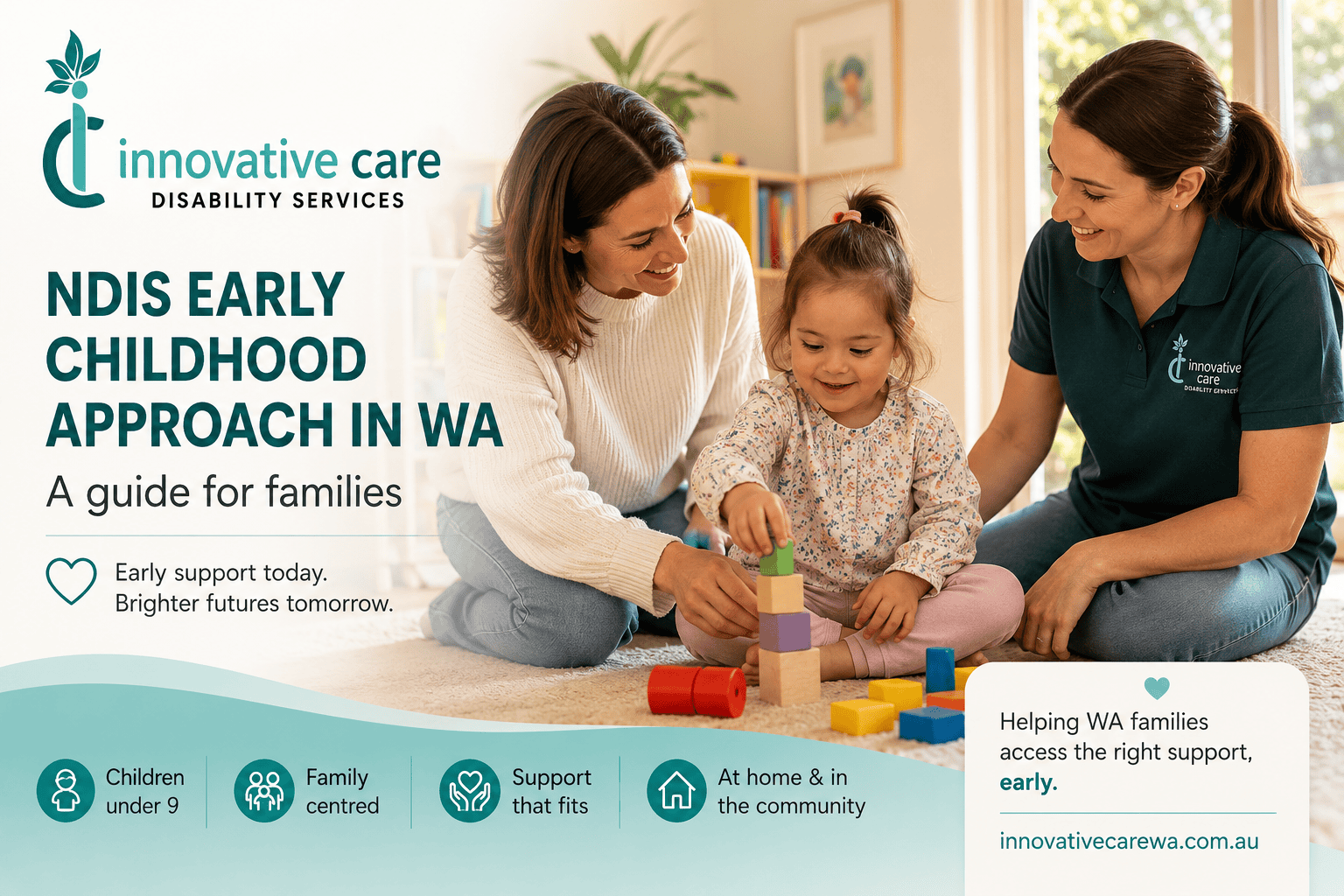
If you’ve noticed your child is taking a little longer to reach certain milestones — talking, walking, playing, or connecting with others — it’s natural to feel a mix of worry and uncertainty about what to do next. The good news is that in Western Australia, support is available early, and you don’t have to navigate it on your own.
The NDIS early childhood approach is designed for exactly this moment. It’s a dedicated pathway that helps young children with developmental delay or disability — and their families — get the right support as early as possible, when it makes the biggest difference.
This guide explains what the early childhood approach is, who it’s for, and how to get started in WA — in plain English, with Perth families in mind.
What is the NDIS early childhood approach?
The early childhood approach is the way the NDIS supports young children with developmental delay or disability. Rather than expecting families to apply to the NDIS on their own first, it gives you a friendly, expert first point of contact — an early childhood partner — who helps work out what your child needs and connects you to support.
It’s built on a simple idea backed by decades of research: the earlier a child gets the right support, the better their long-term outcomes. Early support can help build a child’s skills, confidence, and independence during the years when their development is happening fastest.
Importantly, the approach is family-centred. Support isn’t just aimed at the child in isolation — it’s built around your whole family, because parents and carers are the biggest influence on a young child’s development. The goal is to give you the knowledge, strategies, and connections to support your child in everyday life.
Quick reference: who the early childhood approach can help
- Children younger than 6 with developmental delay or developmental concerns, or
- Children younger than 9 with disability.
You do not need to already be on the NDIS to get help through the early childhood approach. If you’re worried about your child’s development, you can start by speaking with your GP, child health nurse, early childhood educator, or local early childhood partner — and in many cases you don’t need a formal diagnosis to get started.
Who is it for? Understanding the age range
The early childhood approach supports young children under 9, but the pathway works slightly differently depending on your child’s age and needs. Within that, there are two broad situations:
- Children younger than 6 with developmental delay — where a child isn’t developing skills you’d expect for their age, even without a specific diagnosis.
- Children under 9 with disability — where a child has a diagnosed disability that affects their everyday functioning.
The reason the approach casts a wide net is deliberate. Development in the early years can be hard to predict, and families often notice something is “not quite right” long before there’s a clear label for it. The early childhood approach is designed so that children can get support based on need, not just on having a diagnosis.
Once a child turns 9, if they need ongoing NDIS support they move onto the general NDIS pathway rather than the early childhood approach — but the supports and funding already in place continue through that transition.
What an early childhood partner can help with
In WA, the early childhood approach is delivered by early childhood partners — local organisations funded by the NDIS to work directly with families. When you get in touch, an early childhood professional (often with a background in areas like early childhood education, allied health, or social work) will talk with you about your child and your family’s day-to-day life.
Depending on what your child needs, an early childhood partner can:
- Provide information and advice about your child’s development and what might help.
- Connect you to mainstream and community services — such as your GP, child health nurse, playgroups, or your child’s school or daycare (often called early connections).
- Arrange short-term early supports directly, where that’s the right level of support for your child’s needs.
- Help you apply to the NDIS for longer-term funded support, if your child is likely to need it — and support you through that process.
For many families, the right support is a combination of these — not necessarily an NDIS plan straight away. That’s a feature of the approach, not a barrier: it means your child gets the right amount of support for where they’re at, and it can step up if needs change.
Early connections may be enough for some children
Not every child who contacts an early childhood partner will need an NDIS plan. Some families receive information, community and mainstream connections, peer support, or short-term early supports first — and for many children, that early help is exactly what’s needed.
You don’t need a diagnosis to get started
One of the most common reasons families delay reaching out is the belief that they need a formal diagnosis first. For the early childhood approach, that’s usually not the case.
If you have concerns about your child’s development, that’s enough to make contact. An early childhood partner can talk through what you’re seeing and help you work out the next step — whether that’s some early advice, a connection to a local service, or beginning an NDIS application.
How the early childhood approach fits with the NDIS
It helps to think of the early childhood approach as the front door to disability support for young children in WA — not a separate scheme, but the way the NDIS is delivered for this age group.
Some children who come through this door will receive short-term early supports and community connections without ever needing an individual NDIS plan. Others — particularly those with a disability or higher support needs — will be supported to apply for the NDIS and, if approved, receive funded supports through an NDIS plan.
If your child does end up with an approved plan, the funding is organised into support categories, just like any NDIS plan. Our guide to how NDIS funding is structured explains what those categories mean and how to make the most of them once you’re at that stage.
How to get started in WA (step by step)
Getting started is more straightforward than most families expect. Here’s what the process usually looks like:
Step 1 — Talk to a professional who already knows your child. Your GP, child health nurse, early childhood educator, daycare, or school is a good first conversation. They can help you understand what you’re seeing and point you in the right direction.
Step 2 — Understand the likely pathway. Depending on your child’s needs, that might mean community and mainstream supports, early connections, short-term early supports, or applying for NDIS access. Not every child needs an NDIS plan.
Step 3 — Contact your local early childhood partner. WA is covered by early childhood partners across the Perth metro area and regional areas. You can find the partner for your area using the office finder on the NDIS website (ndis.gov.au), or by calling the NDIS on 1800 800 110. You’ll have a supportive conversation about your child — there’s no test to pass.
Step 4 — Work through supports and next steps. The partner will suggest a path forward — practical advice, a connection to a community service, short-term early supports, or beginning an NDIS access request. If an application is involved, they help you gather the evidence you need and guide you through it. The aim is to get support in place without long delays, because in early childhood, timing matters.
If you’re wondering about timeframes for the NDIS side of things, our guide to how long NDIS access decisions take in WA gives a realistic picture of what to expect.
What early support can look like day to day
Early support doesn’t usually mean clinical appointments in a waiting room. Increasingly, best-practice early childhood support happens in your child’s natural environment — at home, at daycare, at the park — woven into the ordinary moments where children learn best.
That can look like:
- A professional coaching you on simple strategies to build your child’s communication or play skills during everyday routines.
- Support workers or therapists working alongside your child’s daycare or kindy to help them take part more fully.
- Practical help for the whole family — because supporting a young child’s development is a team effort.
The thread running through all of it is the same: build the child’s skills and independence, and build the family’s confidence to keep that going every day.
A quick comparison: is this the right pathway for my child?
| Your situation | The early childhood approach can help |
|---|---|
| Child under 6 with developmental delay or concerns | Yes — start here, even without a diagnosis |
| Child under 9 with a disability | Yes — this is the pathway to NDIS support for young children |
| You’re unsure whether it’s “serious enough” | Yes — reach out; the partner will help you work that out |
| Child is 9 or older | The general NDIS pathway applies instead |
If you’ve been going back and forth about whether to reach out, the honest answer is that early is almost always better. There’s no downside to a conversation, and it can save months of wondering.
How Innovative Care can help
Once your child is connected to the early childhood approach, the next question is who delivers the day-to-day support. That’s where we come in.
Innovative Care is an NDIS-registered provider delivering early childhood supports for children in WA. (We’re a provider of supports, which is different from an NDIS early childhood partner — the partner is the funded organisation that helps you access the approach in the first place.) Whether your child has funded supports through an approved NDIS plan, or your family is still working through the early childhood pathway, we can help you understand what practical support may look like and how to prepare for the next step.
We work in a family-centred way — supporting your child’s development in everyday environments, at home and in the community, alongside the routines that already shape their day. Our focus is on helping your child build skills, confidence, and participation, while giving parents and carers clear, practical strategies to use between support sessions.
If you’re still at the beginning of the process, we can also help you understand what questions to ask, what information may be useful to gather, and how to think about the supports your child might need. And being local matters for this: we’re a Perth-based team who understand how the early childhood approach works in WA — not a call centre interstate.
Wondering what support could look like for your child? Talk to our Perth team for a calm, no-pressure conversation about your child and what’s possible.
Frequently asked questions
What is the NDIS early childhood approach?
The early childhood approach is how the NDIS supports young children and their families — children younger than 6 with developmental delay, and children younger than 9 with disability. Families work with a local early childhood partner who provides advice, connects them to services, arranges short-term early supports, or helps them apply to the NDIS if longer-term support is needed.
What age does the NDIS early childhood approach cover?
It supports children under 9 years of age. This includes children under 6 with developmental delay and children under 9 with a disability. Once a child turns 9, ongoing NDIS support continues through the general NDIS pathway.
Do I need a diagnosis for my child to access early childhood support?
Usually not. If you have concerns about your child’s development, that’s enough to contact an early childhood partner. Support through the early childhood approach is based on your child’s needs, not just on having a formal diagnosis.
How do I find an early childhood partner in WA?
You can find the early childhood partner for your area on the NDIS website (ndis.gov.au) under “Find an early childhood partner,” or by calling the NDIS on 1800 800 110. Partners operate across the Perth metro area and regional WA.
Does my child automatically get an NDIS plan through the early childhood approach?
No. Many children receive short-term early supports and connections to community services (early connections) without needing an individual NDIS plan. Children with a disability or higher support needs may be supported to apply for the NDIS and, if approved, receive funded supports through a plan.
Is early childhood support free?
Support provided through an early childhood partner — including information, advice, and connections to services — is funded by the NDIS at no cost to families. If your child is approved for an NDIS plan, the funded supports in that plan are also covered by the NDIS.
Early support is one of the best things you can do
Reaching out about your child’s development can feel like a big step — but it’s rarely as daunting as the worry that comes before it. The NDIS early childhood approach exists precisely so that WA families don’t have to figure this out alone, and so that children get support during the years it counts the most.
If something feels “not quite right,” you’re allowed to ask. A single conversation can bring clarity, reassurance, and a clear next step — and when it comes to putting the right early childhood supports in place, our Perth team is here to help work through what comes next.