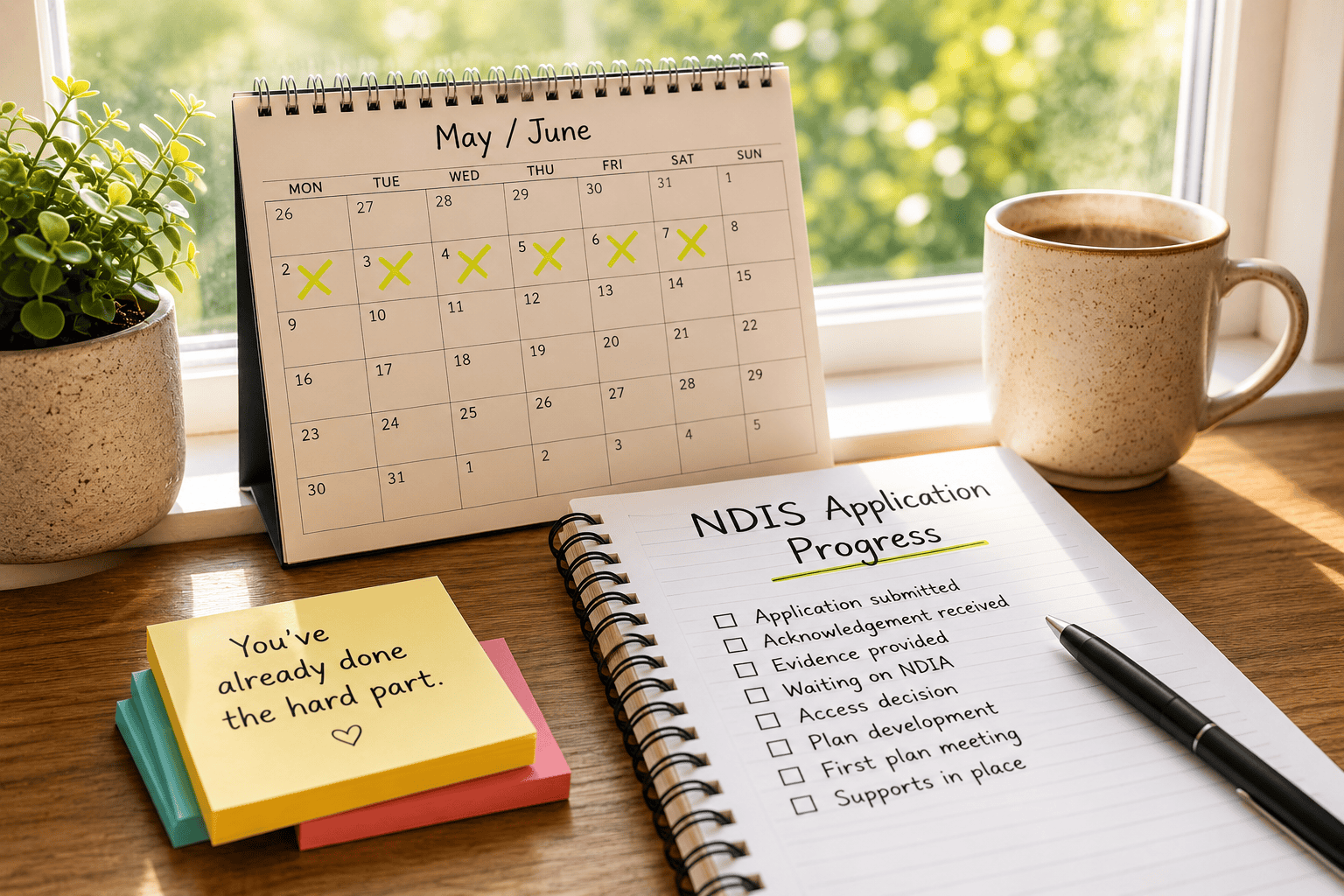
The hardest part of an NDIS application isn’t filling in the forms — it’s the silence afterward. You hand over months of evidence, hit submit, and then nothing happens for a while. It’s the kind of waiting where every day feels equally important and equally pointless.
If you’re sitting in that gap right now, the good news is there is a process, there are clear stages, and there are practical things you can do during the wait to keep your application moving. This guide walks through what the timeline actually looks like in Western Australia, where applications commonly slow down, and the five practical steps that genuinely help.
The official NDIS timeline (what the rules say)
The NDIS has legislated targets for each stage of an application. These are the timeframes the National Disability Insurance Agency (NDIA) is supposed to meet:
- 21 days to acknowledge receipt of your Access Request.
- 21 days to make an Access Decision — but this clock only starts after they have received all the information they reasonably need.
- 56 days to develop and approve your first NDIS plan once access is granted.
- Then plan implementation — meeting with your support coordinator or LAC, agreeing on supports, signing service agreements, and starting services.
These are statutory targets, not real-world guarantees. They’re useful as a reference point — and useful when you need to know whether your application is genuinely overdue — but most applications take longer than the minimums above.
What the timeline actually looks like in practice
Here’s a more honest picture of what most Western Australian participants experience:
| Stage | What people commonly experience |
|---|---|
| Acknowledgement of your Access Request | Usually within a few weeks |
| Access decision | Often several weeks to a few months |
| First plan approval | Often several weeks to a few months after access is granted |
| First plan meeting and implementation | Varies depending on your supports and provider availability |
Many people begin actually using their NDIS funding somewhere between four and nine months after starting the process. Some straightforward applications move much faster than this, while others take considerably longer — particularly for psychosocial disability, complex needs, or applications where the NDIA has had to come back asking for additional evidence.
The important thing to understand is that waiting does not automatically mean something is wrong.
Approval isn’t the finish line
Many people assume “approved” means “funding starts.” It doesn’t quite. After your Access Decision is approved, there’s still:
- First plan development by the NDIA
- A plan meeting (usually with an LAC) to walk through your supports
- Choosing providers and signing service agreements
- Setting up support coordination (if it’s in your plan)
Each of those steps takes its own time. Knowing this up front makes the wait feel less mysterious — and lets you plan the practical pieces (like shortlisting providers and reading up on how NDIS plan funding works) while you wait.
Why your application might be taking longer
Most slow applications aren’t stuck — they’re working their way through. But it helps to know which of the common holding patterns yours is in.
Consider one common pattern: an applicant submits her Access Request in late summer. Three weeks later she receives acknowledgement, but then hears nothing for nearly two months. After calling the NDIA she discovers a request for additional evidence had been mailed to an old address. Once her occupational therapist provides the updated report, her application starts moving again. None of that was visible to her from the outside.
Five reasons applications often slow down:
- The NDIA has requested more information and you haven’t seen the letter yet. They often write by post in WA, and the letter can sit in a junk-mail pile, arrive at an outdated address, or land after the deadline they’ve asked you to meet.
- Your initial evidence didn’t clearly show functional impact. The NDIA isn’t rejecting — they’re pausing while they look for more. A common trigger for the silence.
- Your application is waiting in a review queue. Sometimes the delay isn’t missing evidence at all — it’s simply waiting for the next available assessor or planner to pick up your file.
- Your professional evidence sources are slow to respond. When the NDIA asks your psychiatrist, OT, or specialist for more, the wait depends on their schedule, not yours.
- Your application has been flagged for complex review. Some files go to a senior planner — slower, but often more thorough, and frequently a better outcome.
Knowing which of these you’re sitting in is the first step to nudging things forward.
How to speed it up — five practical steps
This is the part of the article most worth bookmarking. Five things you can actually do this week:
1. Call the NDIS and ask for a status update
Phone 1800 800 110, give them your Access Request number, and ask directly:
- “Has any further information been requested from me?”
- “What’s the next step on my file?”
- “Is my application currently waiting on the NDIA or on me?”
Take notes — names, dates, what was said. Even if the update is small, you’ll have a clearer picture of what happens next.
2. Check your inbox and your physical mailbox
The NDIA still sends important information requests by post in WA. A letter sitting in a pile of bills can quietly stall an application for weeks. Worth a five-minute sweep.
3. Submit stronger functional evidence proactively
If your initial evidence was thin — particularly the parts describing day-to-day impact — don’t wait to be asked. Send an updated Occupational Therapy assessment, a more detailed specialist letter, or a personal statement directly to the NDIA or through your LAC. Stronger evidence shortens the back-and-forth. Strong supporting evidence that explains how your condition affects daily life is often more valuable than additional medical diagnoses.
4. Get your LAC involved
In WA, Mission Australia runs Local Area Coordinator (LAC) services for most regions. LACs can sometimes follow up internally on your behalf in ways an individual applicant cannot. This is free and one of the most underused options.
5. Ask a disability advocate to help
WA advocacy services — People With disabilities WA (PWdWA), Developmental Disability WA, Mental Health Law Centre WA — can help ensure communication doesn’t break down and assist if your application appears stalled. They know the system and can write follow-up requests through formal channels.
A small bonus tip: keep a log. Every call, every letter, every date, every name. If things ever stall and you need to escalate, this becomes invaluable evidence.
Signs your application is genuinely stalled (vs. just slow)
It helps to know the difference between “this is just how it goes” and “something is wrong.” Reasonable signs to actively push:
- 6+ weeks of silence with no acknowledgement of your Access Request → call to confirm it was received.
- 3+ months past your last evidence submission with no decision → ask formally where your file sits in the queue and what’s needed next.
- You’ve been told “more evidence needed” twice without specific guidance on what → time to involve an advocate.
- Different NDIA officers giving you conflicting information → request a single point of contact in writing.
- Repeated promises without follow-through → escalate via the NDIS Complaints line on 1800 035 544.
One of these is annoying. Two or three together is a sign your application needs a nudge.
A few WA-specific things worth knowing
- LAC coverage in WA runs through Mission Australia across most Perth regions (Joondalup, Osborne Park, Midland, Rockingham, Mandurah) and parts of regional WA.
- Regional WA applicants sometimes face additional steps for assessments, though virtual assessments are now common and have reduced delays compared to a few years ago.
- Aboriginal participants in WA can sometimes access targeted support through community-controlled disability organisations, which can help speed evidence gathering and follow-up.
If you’re already connected with a local disability organisation, ask whether they have experience helping people gather NDIS evidence. The quality of evidence often affects timelines more than the application form itself.
Frequently asked questions
How long does the NDIS take to decide on an application in WA?
The legislated target is around 21 days from when the NDIA has received all the information it reasonably needs — but in practice, many applicants in WA wait several weeks to a few months for an Access Decision. Total time from application to actually using your funding is more commonly in the four-to-nine-month range, with significant variation by complexity and evidence strength. The biggest single factor is whether the NDIA already has all the evidence it needs at the start — applications with strong functional evidence almost always move faster.
Can I follow up on my NDIS application?
Yes — and you should. The NDIS contact line is 1800 800 110. Ask whether more information has been requested, what step your file is on, and whether your application is waiting on the NDIA or on you. Following up is normal, expected, and often genuinely helpful.
What if the NDIS asks for more evidence?
Treat the request as a clear signal of what’s missing. Common asks: a detailed Occupational Therapy assessment, a specialist report describing functional impact (not just diagnosis), or a personal statement about day-to-day life. The faster and more specifically you respond, the faster the clock restarts.
Does using a Local Area Coordinator speed things up?
LACs can’t override NDIA timeframes, but they can often check on your application internally, help you understand requests, and prevent communication breakdowns. They’re free, and in WA they’re widely available through Mission Australia. Using one rarely hurts and frequently helps.
What’s the difference between access approval and a first plan?
Access approval just means the NDIS has accepted you as a participant. After that, there’s a separate process to actually build your first plan — including a plan meeting and discussion of your goals and supports. Funding only starts when the first plan is approved and implemented.
Is there a way to fast-track an NDIS application?
There’s no official “fast-track” lane, but applications with strong initial evidence — especially clear functional impact reports from the right professionals — generally move faster because they trigger fewer follow-up requests. Front-loading your evidence is the most reliable way to shorten your timeline.
Can I start receiving support while waiting for NDIS approval?
Yes, often. While you wait, options include: a Mental Health Care Plan or Chronic Disease Management Plan through your GP (Medicare-funded allied health sessions), community mental health services, state-funded disability supports, and many community organisations that don’t require an NDIS plan. Don’t put your needs on hold during the application — most services can help you in the meantime.
A gentle next step
If you’re mid-wait and trying to figure out what your next move should be — whether that’s a status call, stronger evidence, or just understanding where you sit — we’re happy to talk it through. No pressure, no commitment, just a friendly conversation about your situation and the practical options.
You can get in touch with our team for a friendly chat, learn more about the NDIS application process step-by-step, or read what to do if your application is rejected if that becomes relevant.
The wait is frustrating. It’s not the same as being stuck — and you don’t have to navigate it alone.
Reviewed by the Innovative Care coordination team — Perth-based coordinators and senior support staff with hands-on experience supporting NDIS participants across applications, plan reviews, advocacy, community participation, and in-home support services in Western Australia. Last reviewed: 2 June 2026.