Receiving an approved NDIS plan is a significant milestone — but for many participants and families across Perth and Western Australia, the next question is immediate: “Now what do I actually do with it?”
This guide explains the three NDIS funding categories, the most common budget mistakes, and practical ways WA participants can make the most of their plan — in plain English, without the jargon.
At Innovative Care, we’re a registered NDIS provider working with participants across Perth and regional WA. Helping people understand their plans is part of what our team does every day.
How Your NDIS Plan Budget Works
Your NDIS budget is the funding allocated in your plan to pay for supports that help you pursue your goals and live more independently. It’s calculated based on your individual disability-related needs, your circumstances, and the goals you’ve agreed on with the NDIA.
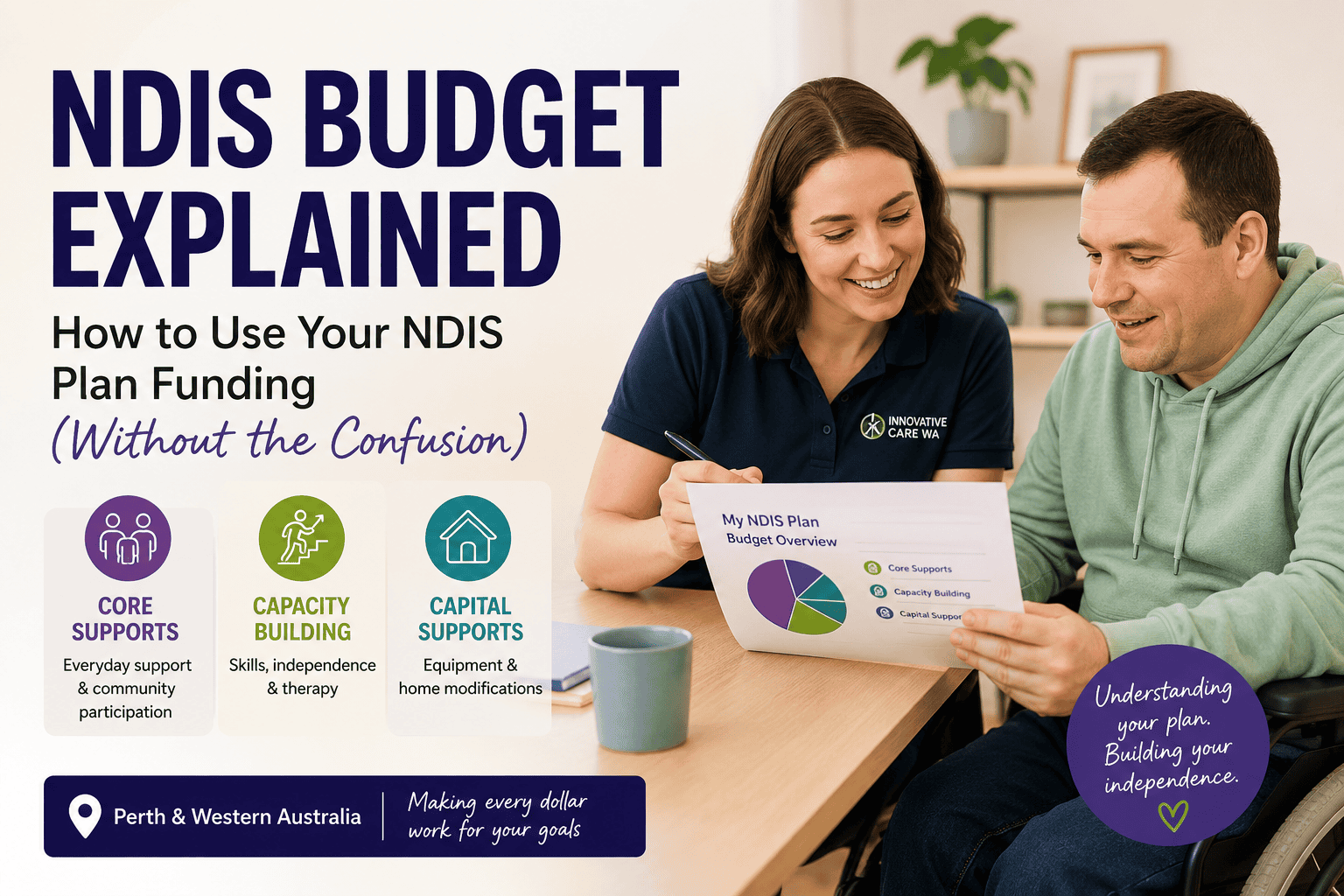
The budget isn’t a single pool of money. It’s divided into three separate funding categories — Core Supports, Capacity Building, and Capital Supports — each with its own rules about what it can cover. Understanding these categories is the foundation of knowing how to manage NDIS funding effectively.
Understanding the 3 NDIS Funding Categories
Here’s a quick overview before we step through each one:
| Funding Category | What It Covers | Flexible Between Subcategories? |
|---|---|---|
| Core Supports | Everyday support & community access | Usually yes |
| Capacity Building | Skills, independence & therapy | In most cases, no |
| Capital Supports | Equipment & home modifications | No |
1. Core Supports
Core Supports is typically the largest portion of your NDIS budget. It funds the everyday support you need to complete daily activities and participate in your community.
- Assistance with Daily Life — personal care, cooking, cleaning, and household tasks
- Assistance with Social & Community Participation — support to access activities, social groups, and events across Perth and WA
- Transport — getting to appointments, work, or community activities when public transport isn’t a viable option
- Consumables — everyday items such as continence products or low-cost assistive technology
Core Supports are usually flexible. In most cases, you can shift funding between Core subcategories without needing a plan change — giving you room to adapt as your needs change throughout the year.
Real-world example: A participant in Perth with a physical disability had Core Supports allocated across daily living and community access. When she joined a weekly social group during winter, she was able to redirect some of her daily living hours toward community support — without needing to contact the NDIA or change her plan.
2. Capacity Building Supports
Capacity Building is designed to help you build skills and independence over time — so that over time, you may need less funded support for certain tasks.
- Support Coordination — helping you understand your plan and connect with the right providers in WA
- Improved Daily Living — therapy with occupational therapists, speech pathologists, and other allied health professionals
- Improved Health & Wellbeing — allied health services like dietetics or exercise physiology
- Improved Living Arrangements — support to find and maintain appropriate housing
- Improved Learning — assistance transitioning into education or employment
Capacity Building funding is typically fixed to its allocated purpose. Unlike Core Supports, funds in this category cannot usually be moved between subcategories — so it’s important to use it for what it was allocated for.
Real-world example: A young WA participant had $4,800 in Capacity Building for Improved Daily Living. His family weren’t sure what this covered, so the funding sat untouched for nearly eight months. When they eventually connected with an occupational therapist through their local provider, they were able to use the remaining funds for a home assessment and skill-building sessions — but they lost months of valuable therapy time. Earlier guidance would have made a significant difference.
3. Capital Supports
Capital Supports covers higher-cost, one-off investments that help you live more independently or participate more fully in daily life.
- Assistive Technology — wheelchairs, communication devices, and specialised equipment
- Home Modifications — structural changes such as ramps, grab rails, or accessible bathrooms
- Specialist Disability Accommodation (SDA) — for participants with very high support needs requiring specialised housing
Capital Supports is the least flexible of the three categories. Funding is tied to specific approved items, and in most cases you’ll need quotes, assessments, and NDIA approval before drawing on it.
A Common Pattern We See Across WA Participants
“One of the most frequent issues we come across is participants waiting too long to activate their supports — often because they’re still figuring out how their funding works. By the time they feel confident, they’ve already underspent a significant portion of their plan. Unfortunately, that can affect the funding they receive at their next review.”
— Innovative Care Support Team
If you’re new to your plan or recently had a review, getting started with the right supports early makes a genuine difference. Our team is always happy to walk you through it — get in touch here.
Common NDIS Funding Mistakes — and How to Avoid Them
Underspending
Underspending happens when you don’t use all of your allocated funding before your plan review. It’s more common than most people expect — particularly in the first year of a new plan.
The real risk: The NDIA monitors how much of your plan funding you actually use. Consistent underspending can indicate that your needs are lower than originally assessed, which may result in reduced funding at your next review.
Real-world example: A participant approved for 12 hours of support per week only used around 5–6 hours during the first three months because he was still searching for the right provider match. By the time he found a suitable support worker, he’d fallen significantly behind on his support hours — and the data made it look like he needed less support than he actually did.
- Book supports consistently — don’t wait until the final few months of your plan to ramp up
- Work with a support coordinator to identify and fill any gaps in your support schedule
- Track your spending monthly using the myplace participant portal or your plan manager’s reporting tools
- Ask your provider about additional services aligned with your goals if you have remaining hours to fill
Many Perth participants work with a local provider to keep their spending on track throughout the year. Regular check-ins with your support team make a meaningful difference.
Overspending
Overspending means your funding runs out before your plan period ends — leaving you without support until a review or reassessment takes place.
Real-world example: A participant receiving daily support was funded for 10 hours of care per week. Following a change in her household situation, her support worker began staying slightly longer each visit — gradually reaching 13–14 hours per week. Without regular tracking, neither the participant nor the provider noticed until her Core Supports budget was nearly exhausted, with seven months still remaining in her plan.
- Set a weekly spending guide at the start of your plan period
- Review your statements monthly — at minimum
- Speak to your support coordinator early if spending is running ahead of schedule
- Confirm your provider’s rates are in line with the NDIS Pricing Arrangements and Price Limits
Practical Tips to Manage Your NDIS Funding Better
- Know your goals — every support you fund should connect back to a goal in your plan
- Choose the right management type — self-managed, plan-managed, or NDIA-managed each offer different levels of flexibility and provider choice
- Review your plan quarterly — don’t wait until your annual review to spot a problem
- Keep your records — hold onto invoices, service agreements, and receipts
- Ask for help early — your support coordinator and plan manager are there precisely for moments of uncertainty
Three things every WA participant should remember:
- Core Supports are usually flexible between subcategories
- Capacity Building funding is typically fixed to its allocated purpose
- Unused funding does not roll over to your next plan period
How Innovative Care Helps Perth Participants Get More From Their Plans
At Innovative Care, we work with participants and families across Perth and regional WA every day — and we understand firsthand how daunting NDIS funding can feel, especially when you’re new to the system or your needs have recently changed.
Our qualified, experienced team takes the time to explain your options in plain language, help you connect your supports with the goals that matter most to you, and make sure your plan is actually working for your life. Whether you need assistance with daily living, support accessing your community, or a support coordinator to help you navigate the system, we’re here to help — without pressure or jargon.
We’re a registered NDIS provider, proudly local to Western Australia, and we genuinely care about the outcomes of the people we support.
📞 Contact us today for a friendly, no-obligation conversation with our local team.
Frequently Asked Questions About NDIS Funding
Can I use my NDIS budget for anything I choose?
No. Your funding must be used for supports that are “reasonable and necessary” and directly related to your disability. The NDIA provides guidance on what reasonable and necessary supports look like.
What can’t NDIS funding be used for?
NDIS funding typically cannot cover day-to-day living costs unrelated to your disability (such as rent, groceries, or utility bills), treatments not considered reasonable and necessary, or supports that fall under another government system — such as Medicare-funded healthcare.
What happens if I don’t spend all of my NDIS budget?
Unspent funding doesn’t roll over to your next plan. Consistent underspending can signal to the NDIA that you don’t need as much support — which may result in reduced funding at your next review. Using your supports regularly and in line with your goals helps protect your funding level.
Can I save my NDIS funding?
No. NDIS funds must be used within the current plan period for approved supports. You cannot accumulate or carry funding across plan periods.
How often should I check my NDIS budget?
At minimum, once a month. You can check your balance at any time via the myplace participant portal.
Can I switch between NDIS budget categories?
Core Supports funding is usually flexible between its subcategories. Capacity Building and Capital Supports are not interchangeable — as a rule, they’re fixed to their allocated purpose. Significant reallocation typically requires a formal plan variation or review.
Do I need a plan manager to manage my NDIS budget?
Not necessarily. You can choose to be self-managed, plan-managed, or NDIA-managed. Plan management is a popular middle ground — your plan manager handles payments and reporting while you retain flexibility over which providers you work with.
Can my support worker help me manage my budget?
Your support worker can help you understand how your supports connect to your goals, but budget management sits with you, your plan manager, or your support coordinator — not your support worker directly.
Ready to Get More From Your NDIS Plan?
Understanding how NDIS funding works is the first step. Using it consistently and in line with your goals is what makes the real difference day to day.
If you’re a participant or family in Perth or Western Australia and you’re unsure where to start — or you feel like your current supports aren’t quite right — the team at Innovative Care is here to help.
👉 Contact us to learn more — or reach out for a friendly chat with our local team. No pressure, no jargon, just honest support.
NDIS rules, support categories, and pricing arrangements can change over time. The information in this article reflects current NDIA guidelines but should not replace personalised advice from the NDIA, your plan manager, or your support coordinator. Always confirm current eligibility and pricing with the NDIA or your plan manager.
Innovative Care is a registered NDIS provider serving participants across Perth and Western Australia. Our qualified support workers and coordination team offer a range of NDIS-funded services tailored to your goals and lifestyle.