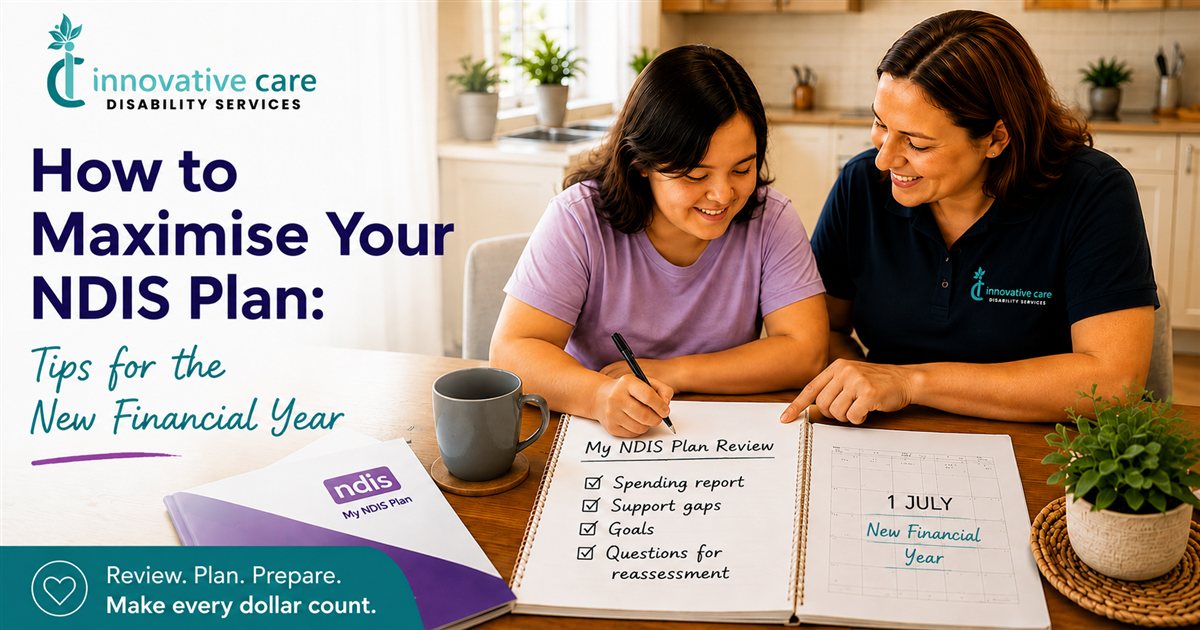
NDIS planning isn’t just paperwork — it’s about balancing your life. A good plan should make daily life easier, not more complicated. If you want to maximise your NDIS plan before the new financial year, the best place to start is by reviewing what has worked, what has gone unused, and what support you may need next.
And it’s completely normal to feel a bit anxious, or to have a hundred questions swirling around before a meeting. Sometimes it’s hard to find the right words, or maybe you feel a little shy about asking questions during your planning meeting or reassessment. If that sounds like you, you’re not alone — and with the new financial year approaching, now is the perfect time to get prepared.
In this blog, we’ll walk through the key things to keep in mind as a participant so you can head into your next plan with confidence.
Preparing for your plan reassessment
Think of your plan reassessment (still often called a “plan review”) as a check-in. Take an honest look at what’s genuinely making your day-to-day life easier, and what feels like it’s missing the mark. It’s the best time to ask yourself: is this plan still working for me, or do some things need to shift? Does it still match my current circumstances and goals?
You’ll also want to review your annual spending patterns before the new financial year begins. Running a quick “audit” of your own spending helps you show the NDIA how you’ve used your funding and how much you’re likely to need for the year ahead.
Why review your spending patterns?
To explain unused funding clearly. If you have leftover funding, look into why. Did a provider cancel? Did your schedule change? Was there a waiting list? Significant unspent funds can prompt questions at your reassessment — the NDIA may wonder whether your full budget is needed — so it helps to be ready to explain the gaps. Coming prepared with the reasons puts you in a much stronger position.
To identify support gaps. Sometimes funding goes unused not because you didn’t need it, but because there weren’t enough providers in your area, or your provider couldn’t attend. This is especially common in regional and remote parts of WA, where support can be harder to access. If you don’t explain these gaps early, it may be harder to show why the funding is still needed in your next plan.
What to check in your records
- Your utilisation rate (your “burn rate”). How much are you spending each month? Is your funding being used steadily, or barely touched?
- Category spending. Which category are you spending most in — for example, Core Supports vs Capacity Building? Does that match your priorities and goals?
- Inconsistencies. Are there months with little or no spending? Maybe an emergency meant you missed therapy. These are exactly the kinds of things worth explaining to your NDIS planner.
- Provider trends. Are there invoices that weren’t processed? Are any providers too expensive, or not delivering good service?
How to do it: a step-by-step process
- Download your spending report. From your Plan Manager or your myplace portal, get a summary of all transactions from the past 12 months.
- Note the gaps. List the months where funding wasn’t used, along with the valid reasons. For example:
- “July–August: No therapist available in my area.”
- “December: I was hospitalised and couldn’t attend sessions.”
- Compare against your goals. Check whether your spending is helping you meet the goals in your plan. If not, your supports may need adjusting for next year.
- Document it for your meeting. Take notes and list everything you want to raise, so you can clearly explain your needs — and whether your budget is enough or needs adjusting — at your reassessment.
Expect different plan lengths
Be prepared for your next plan to run for a different length of time. Depending on the outcome of your reassessment and how stable your support needs are, the NDIS may shorten or lengthen your plan cycle.
Tweaking your budget and funding categories
Your supports or funding may need to be adjusted if your day-to-day needs have changed — but any request to shift funding needs to tie back clearly to your stated goals. Focus on the support you actually need to function well, rather than trying to fit your life into rigid funding boxes.
Some parts of your plan may be more flexible than others, so it’s worth checking what can be used within each support category before assuming funds can be moved around. If your needs have changed, write down what has changed, what support you now need, and how it connects to your NDIS goals.
Understanding updates to NDIS pricing and funding rules
We know — reading through NDIS price guides isn’t anyone’s idea of a good weekend. But think of it as a bit of “financial self-defence.” The NDIS reviews price limits each year, with annual pricing changes generally applying from 1 July. Updates can also happen during the year, so it’s worth checking the current NDIS Pricing Arrangements before signing or renewing a service agreement. You don’t need to be an accountant; knowing the basics helps you catch mistakes before they drain your budget. When in doubt, just send a quick message to your Plan Manager — that’s what they’re there for.
Why keep an eye on these updates?
- Indexation and price increases. Prices are often adjusted to keep pace with support workers’ wages (for example, under the Social, Community, Home Care and Disability Services Industry — SCHADS — Award). If you’re not aware of the new price caps, you might be surprised to find your funds running out faster than last year.
- Rule changes in support categories. Sometimes the NDIA changes what can be claimed within a funding category — a service that was once “Core” support might move to “Capacity Building,” or vice versa. If you’re not across these changes, you may be caught out when funds can no longer be used for a previously approved service.
- Travel and cancellation policies. This is where “hidden charges” often creep in. The NDIS has clear rules on what can be charged for travel time and cancellations. Knowing them means you can question a provider if a charge looks too high.
How to keep track without the overwhelm
- Bookmark the official site. Don’t rely only on what you see in Facebook groups — check the official NDIS Pricing Arrangements page at the start of each financial year.
- Ask your Plan Manager. They’re the financial experts. Before signing a new service agreement, email them and ask: “Are these rates still within the current NDIS price limits?”
- Check your service agreement. Make sure the rates in your contract match the current price limits, and don’t agree to open-ended charges.
You don’t have to navigate this alone
We know all of this can feel overwhelming at times — but please don’t let the confusion get to you. You’re not in this on your own. As a local, NDIS-registered provider here in Western Australia, the Innovative Care team is always happy to help you make sense of your plan and your options.
Need help understanding your NDIS plan before the new financial year? Contact Innovative Care and our local team can help you review your supports, identify gaps, and plan your next steps with confidence. Email us at info@innovativecarewa.com.au or call 08 6202 0120.