If you or someone you love is on an NDIS plan here in Western Australia, you have probably heard that the prices changed again on 1 July. It is completely normal to feel a little uncertain when that happens – the NDIS can be a lot to keep track of, and the language around “price limits” and “support items” is not always easy to follow.
The good news is that most of the 2026-27 changes are straightforward once they are explained in plain English. In this guide, our team at Innovative Care walks you through what the latest NDIS price guide means for you as a participant here in WA, what has gone up, what has stayed the same, and what you may want to keep an eye on in your plan.
Quick answer: The NDIS Pricing Schedule sets the recommended maximum prices for many NDIS supports. From 1 July 2026, new 2026-27 prices apply – including a higher standard support worker rate ($73.58/hour), a psychology increase, therapy travel now billed as a separate line item, and continued remote and very remote loadings for eligible WA locations. Your total plan funding does not change just because prices do.
What is the “NDIS price guide”?
The document many people still call the “NDIS price guide” is now published as the NDIS Pricing Schedule. In previous years, similar pricing documents were commonly referred to as the Pricing Arrangements and Price Limits, or PAPL. It is released each year by the National Disability Insurance Agency (NDIA) and sets out the recommended maximum prices for many NDIS support items – and those limits apply differently depending on how your plan is managed.
A few things worth remembering:
- These are price limits, not fixed prices. A provider cannot charge more than the listed limit, but they can charge less.
- The limits apply nationally, with higher allowances for remote and very remote areas – which matters a great deal in WA.
- Your plan budget did not shrink just because prices changed. The amount of funding in your plan is set at your planning meeting. Price changes affect how far that funding stretches, not the total.
Why this matters in Western Australia
WA is a big state, and where you live can change the price limits that apply to your supports:
- Perth metro participants generally use the standard national price limits.
- Some regional, remote and very remote WA participants may have higher limits, depending on whether the support location is classified as remote or very remote (more on this below).
- Travel and provider availability can affect how far your plan stretches, especially outside the metro area.
- It is always worth checking your invoices to make sure the correct location and loading have been applied to your supports.
If you are unsure which limits apply to you, a local provider or support coordinator who knows WA can help you check.
When did the 2026-27 changes start?
The 2026-27 NDIS Pricing Schedule came into effect on 1 July 2026. If you are ever unsure which prices apply to a support, the current document on the NDIS website is always the one to check.
The key changes for WA participants
Here are the updates most likely to affect you or your family.
1. Everyday support work went up
Everyday support – the help you get with things like personal care, daily tasks and getting out into the community – sits in your Core Supports budget. For 2026-27, these rates rose again, largely reflecting the increase to support worker wages under the SCHADS Award.
As a guide, the price limit for a standard weekday support worker (Assistance with Self-Care, daytime hours) increased from $70.23 to $73.58 per hour. Rates are higher in the evenings, on weekends and on public holidays, as they have always been.
2. Therapy travel is now a separate line item
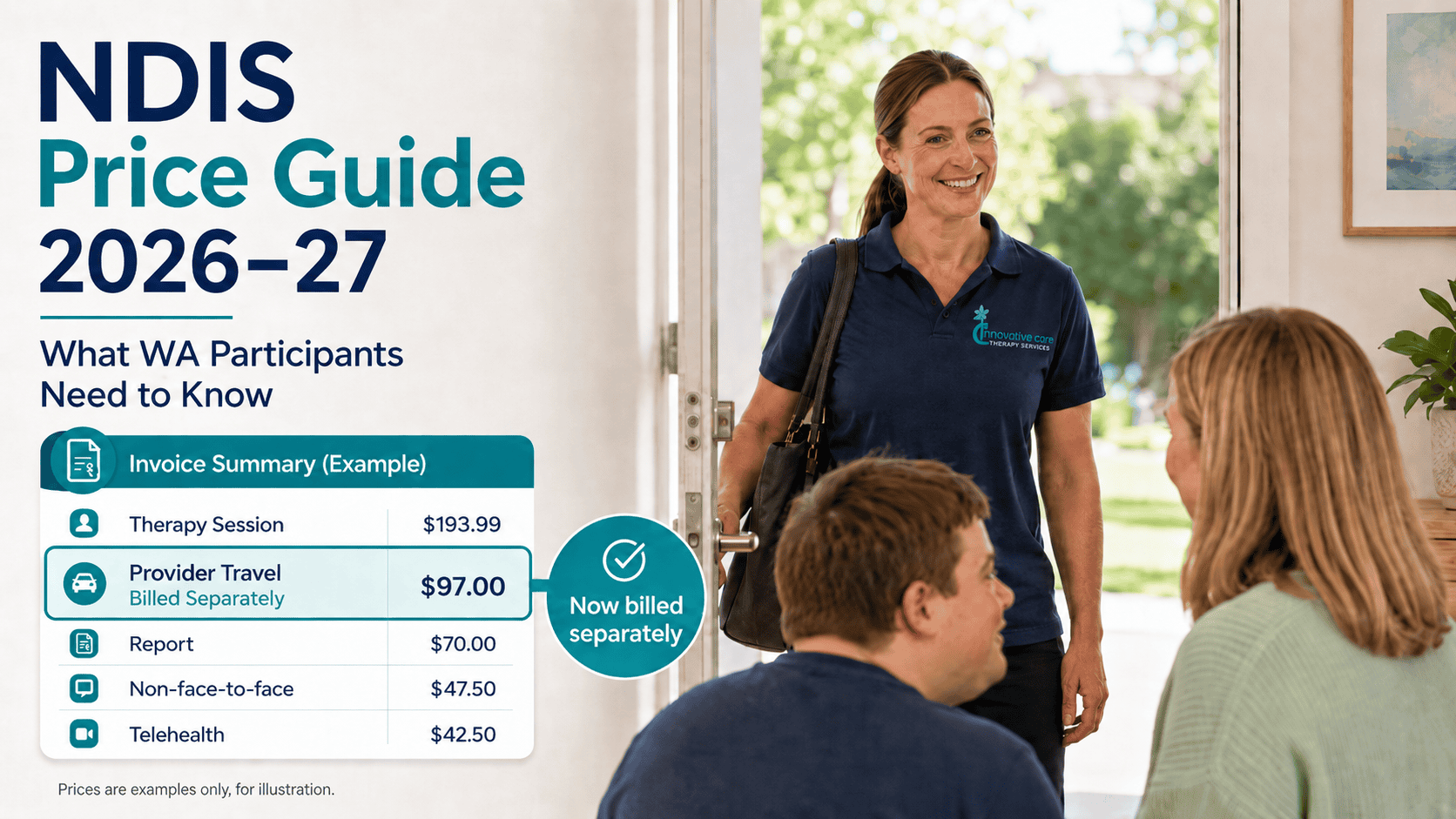
This is one of the bigger structural changes for 2026-27. In the 2026-27 Pricing Schedule, provider travel for therapy appears as a separate support item, alongside related items such as non-face-to-face work, reports and telehealth. In other words, travel is now invoiced on its own line rather than rolled into the session.
Travel is charged at roughly 50% of the therapist’s hourly rate. For example:
- Occupational therapy travel: up to $97.00/hour
- Physiotherapy travel: up to $92.00/hour
- Psychology travel: up to $126.50/hour
Importantly, this 50% travel rule applies to therapy providers (allied health), not to your everyday disability support workers, whose travel is handled under different rules. If your supports are delivered at home, at school or in the community, it is worth asking your therapist how travel will appear on your invoices.
3. Therapy rates: some steady, psychology up
For 2026-27, most therapy hourly limits were held steady, while psychology increased:
- Occupational therapy: up to $193.99/hour (unchanged)
- Physiotherapy: up to $183.99/hour (unchanged)
- Psychology: up to $252.99/hour (increased from $232.99)
For most participants, a steady therapy rate simply means your sessions use a similar amount of budget to last year. If you see a psychologist, it is worth checking how the higher rate affects the number of sessions your plan can cover.
4. Remote and very remote loadings still apply
This one matters especially in WA. Because so much of our state sits outside the metro area, the NDIS continues to allow higher price limits in remote (a loading of around 40%) and very remote (around 50%) locations. If you live or receive supports in regional or remote WA, the limits that apply to you may be higher than the standard national figures above.
How the 2026-27 rates compare
Here is a quick snapshot of some common supports, standard weekday and national (non-remote) rates:
| Support type | 2025-26 rate | 2026-27 rate | What changed |
|---|---|---|---|
| Standard weekday self-care support worker | $70.23/hr | $73.58/hr | Increased |
| Occupational therapy | $193.99/hr | $193.99/hr | Unchanged |
| Physiotherapy | $183.99/hr | $183.99/hr | Unchanged |
| Psychology | $232.99/hr | $252.99/hr | Increased |
These are national, non-remote weekday examples only. Evening, weekend, public holiday, remote and very remote rates may be higher. Provider travel for therapy is now billed separately, at roughly 50% of the therapy rate (for example, $97.00/hr for OT and $92.00/hr for physiotherapy).
Do these limits apply to me? (managed types explained)
How your plan is managed changes how the price limits apply:
- Agency-managed: you must use NDIS-registered providers, and the price limits apply.
- Plan-managed: you can use registered or unregistered providers, but the price limits still apply to what they charge.
- Self-managed: you are not strictly bound by the price limits, so you can negotiate rates. Your spending must still be reasonable, necessary and represent value for money under your plan.
If you are not sure how your plan is managed, your plan manager or support coordinator can confirm it.
What does this mean for your plan?
For most WA participants, the practical takeaways are:
- Check how your therapy hours are tracking, especially if you see a psychologist.
- Expect travel to appear separately on therapy invoices, rather than rolled into the session.
- Do not panic about your total funding. Your plan amount has not shrunk – these changes are about the price limits providers work within.
- Confirm remote loadings if you are regional. If you are outside the Perth metro area, make sure the correct remote or very remote limits are being applied.
- Expect a conversation about any rate change. If your provider changes their rates, they should discuss the change with you and update your service agreement before charging the new amount.
How to check the rates that apply to you
The safest source is always the official document. You can find the current NDIS Pricing Schedule on the NDIS website. If reading a spreadsheet of support items is not how you want to spend your afternoon – and honestly, for most people it is not – a good provider or support coordinator can walk you through the items that actually appear in your plan.
Questions to ask your provider
If you want a simple starting point, these are worth raising with your provider or support coordinator:
- Are you charging the 2026-27 rate from 1 July 2026?
- Will therapy travel appear as a separate line item?
- Does my location attract a remote or very remote loading?
- Will this change the number of hours my current plan can cover?
- Do we need to update my service agreement?
We are here to help – locally
Price guides change every year, and keeping up with them should not fall entirely on you. As a local, NDIS-registered provider based right here in Western Australia, Innovative Care supports participants and families across the state with qualified, caring staff who understand both the paperwork and the people behind it.
If you would like someone to explain how the 2026-27 changes affect your specific plan – or you are simply after friendly, reliable disability support in WA – we would love to hear from you. Contact our team and we will help you make sense of it.
Frequently asked questions
Is the NDIS price guide the same as my plan budget?
No. The price guide sets the recommended maximum prices for many NDIS supports. Your plan budget is the total funding allocated to you, decided at your planning meeting. The price guide affects how far that budget stretches, not the total amount.
Did NDIS prices go up in 2026-27?
Some did. The standard weekday support worker rate rose from $70.23 to $73.58 per hour, and psychology increased to $252.99 per hour. Many therapy rates, such as occupational therapy and physiotherapy, stayed the same.
Why is therapy travel showing separately now?
From 2026-27, provider travel is invoiced as its own line item rather than being bundled into the session. It is charged at roughly 50% of the therapist’s hourly rate. This applies to therapy providers, not everyday disability support workers.
Do remote areas of WA have different price limits?
Yes. Remote and very remote locations attract higher price limits (loadings of roughly 40% and 50%). If you live in regional or remote WA, higher limits may apply to your supports.
Do the price limits apply if I am self-managed?
Not strictly. Self-managed participants can negotiate rates, but spending must still be reasonable, necessary and value for money. If you are agency-managed or plan-managed, the price limits apply to what your providers charge.
Where can I find the official NDIS price guide?
On the NDIS website under Pricing arrangements. It is published as a downloadable document and updated each year. Always treat that document as the source of truth.
This article is general information only and reflects the NDIS Pricing Schedule 2026-27 as at the time of writing. Price limits are updated by the NDIA from time to time – please confirm current figures on the official NDIS website or speak with your provider or support coordinator.
Reviewed by the Innovative Care coordination team – Perth-based coordinators and senior support staff with hands-on experience supporting NDIS participants across plan management, allied health, community participation and in-home support services in Western Australia. Last reviewed: 7 July 2026.