Quick answer: NDIS plans use four support budgets – Core Supports, Capacity Building Supports, Capital Supports and Recurring Supports. Not every participant receives funding in all four. Core Supports is generally the most flexible budget. Capacity Building and Capital Supports are stated for particular purposes. Recurring Supports currently covers eligible everyday transport funding, which may be paid regularly to the participant or claimed through the participant portal or my NDIS app.
If you’ve just received your first NDIS plan – or you’re getting ready for a planning meeting – the funding categories can feel like their own language. Core Supports, Capacity Building, Capital Supports, Recurring Supports, flexible funding, stated items… it’s a lot to take in, especially when you’re also adjusting to everything else that comes with an NDIS journey.
The good news is that once you understand how the support budgets fit together, the rest becomes much easier to follow. Knowing what each budget is for – and how much flexibility you have within it – helps you make confident decisions about your supports, and it means you’ll walk into your planning meeting knowing what to ask for.
This guide breaks the NDIS funding categories down in plain English, with a summary table you can come back to whenever you need a quick refresher.
The Four NDIS Support Budgets at a Glance
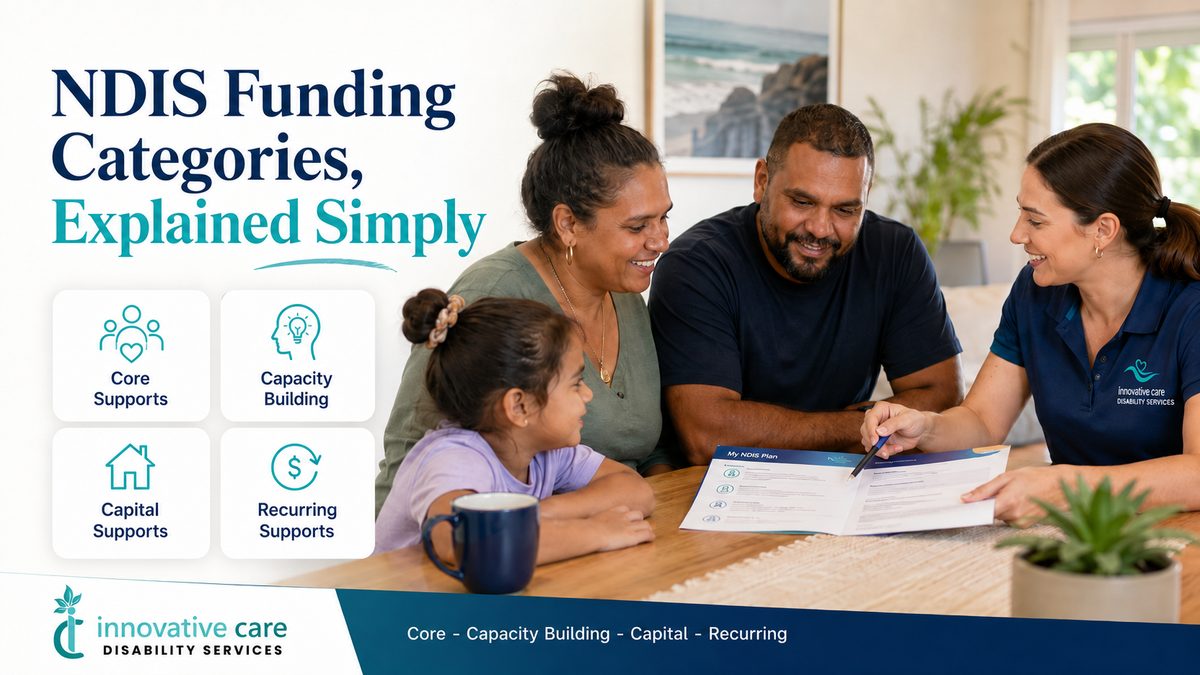
NDIS plans organise funding into four support budgets. Not every participant will receive funding in every budget, but the current structure contains four:
- Core Supports – for everyday activities and disability-related needs
- Capacity Building Supports – for building skills, independence, and long-term capacity
- Capital Supports – for higher-cost equipment, modifications, and specialist accommodation
- Recurring Supports – regular payments, currently used mainly for eligible everyday transport
People often refer to these as NDIS funding categories, but the NDIA (the National Disability Insurance Agency) officially calls them support budgets. Each support budget contains one or more support categories.
Understanding these support budgets is really the foundation of understanding your NDIS budget. Each budget works a little differently, and each one has its own rules about how flexibly the funding can be used. Importantly, funding cannot move between the four support budgets. Let’s go through them one at a time.
Core Supports: The Most Flexible Budget
Core Supports funding helps with the day-to-day, disability-related support that keeps life running smoothly. It’s generally the most flexible part of a plan.
Your Core Supports budget can contain funding across up to three support categories:
- Assistance with Daily Life – help with everyday personal tasks, such as personal care or support around the home
- Consumables – everyday items related to your disability, such as continence products or low-cost assistive technology
- Assistance with Social and Community Participation – for example, having a support worker join you at a community group, class, or social activity
Flexibility: Core Supports is generally the most flexible budget. Where the categories in your plan are marked as flexible, you can usually use the overall Core amount across those flexible categories, depending on what you need most that fortnight or month. Some supports may still be stated for a particular purpose, so always check the wording in your own plan.
A note on transport: You may see two different kinds of transport support. Transport provided as part of another approved support may sometimes be charged from the relevant Core category, depending on your plan and the applicable claiming rules. Everyday transport funding that’s paid to you directly – such as taxis or public transport – now sits under Recurring Supports, which we cover below.
Capacity Building Supports: Building Skills and Independence
Capacity Building Supports funding is all about helping you work toward your goals – building skills, independence, and confidence over time, rather than paying for a support in the moment.
Capacity Building can contain funding across up to nine support categories, including:
- Support Coordination – help understanding and using your plan, and connecting with the right providers
- Improved Living Arrangements – support to find and maintain suitable accommodation
- Increased Social and Community Participation – building skills to take part in community, social, or recreational activities
- Finding and Keeping a Job – support toward employment goals
- Improved Relationships – support to build positive relationships and manage behaviours of concern
- Improved Health and Wellbeing – support connected to your health and physical wellbeing
- Improved Learning – support to assist with education goals
- Improved Life Choices, sometimes displayed as Choice and Control – funding for a registered plan manager
- Improved Daily Living – therapy-based supports such as occupational therapy, physiotherapy, or speech therapy
Flexibility: Unlike Core Supports, Capacity Building funding is stated within each support category. Each category is funded and tracked separately, and the funding within it can only be spent on that specific area. For example, funding allocated to Support Coordination can’t be redirected to Improved Living Arrangements. Within Improved Daily Living, therapy funding can generally be used across suitable therapy types where that’s consistent with the funded purpose.
Capital Supports: For Higher-Cost Equipment and Modifications
Capital Supports pays for medium- and high-cost equipment, assistive technology, vehicle or home modifications, and specialist disability accommodation. Think of this as the budget for larger, less frequent needs rather than day-to-day support.
Depending on your plan format, Capital funding may appear under Assistive Technology, Assistive Technology Repairs and Rental, or Home Modifications and Specialist Disability Accommodation. In plain terms, that can include:
- Assistive Technology – higher-cost equipment such as powered wheelchairs, communication devices, and vehicle modifications
- Assistive Technology Repairs and Rental – approved maintenance, urgent repairs, equipment rental, or related costs
- Home Modifications – approved changes that help you live more safely or independently
- Specialist Disability Accommodation (SDA) – specialist housing funding for eligible participants
Flexibility: Capital funding is stated, which means it must be used for the supports described in the plan. Each amount must be used for the item, service, or modification described in your plan, and it can’t be redirected to another support budget. Your plan will also tell you if reports, assessments, or quotes are required before the funding can be used. If your needs change, that’s a conversation to have with your planner or Local Area Coordinator (LAC) at your next review, rather than something you adjust yourself mid-plan.
Recurring Supports: Regular Transport Payments
Recurring Supports is a separate budget for eligible everyday transport funding. Depending on how your funding is set up, the NDIA may pay it regularly into your nominated bank account, or you may claim it through your participant portal or the my NDIS app. It’s mainly used for everyday transport such as public transport or taxis, where disability makes travelling independently difficult. Recurring funding remains separate from your other support budgets and cannot be topped up with money from Core, Capital, or Capacity Building.
Core vs Capacity Building vs Capital vs Recurring: A Quick Comparison
| Budget | Main purpose | Examples | Flexibility |
|---|---|---|---|
| Core Supports | Everyday disability-related assistance | Personal care, consumables, support to participate in the community | Generally flexible where the plan marks categories as flexible |
| Capacity Building Supports | Building skills and independence | Therapies, support coordination, employment and relationship supports | Stated within each support category |
| Capital Supports | Medium- and high-cost equipment and modifications | Assistive technology, home or vehicle modifications, SDA | Stated for the approved purpose |
| Recurring Supports | Regular direct payments | Eligible everyday transport funding | Flexible within the recurring transport purpose, but separate from other budgets |
Understanding Funding Periods
If you’ve received a new or reassessed plan, you may notice your funding is released in stages rather than all at once. These stages are called funding periods, and they’re commonly set across three-month periods. Instead of your full budget being available on day one, an amount is made available for each funding period across the life of your plan.
Not every support is released in the same way. One-off supports such as assistive technology or modifications may be funded upfront or when needed, while some high-cost regular supports may use shorter funding periods. Your plan will show the dates and amounts that apply to each budget.
This is worth knowing because it affects how you pace your spending – and, as we explain in the FAQ below, what happens to any funding you don’t use within a period.
What Can NDIS Funding Generally Not Be Used For?
NDIS funding can only be used for supports that the NDIS is legally allowed to fund, meet the reasonable and necessary criteria, and are included within the purpose of your plan funding. In practice, a support usually needs to:
- Be an NDIS support (or an approved replacement support)
- Be related to your disability
- Meet the reasonable and necessary criteria
- Be consistent with your plan
Ordinary rent, groceries, utilities, and general household expenses remain examples of costs the NDIS generally does not fund. This isn’t an exhaustive list, and what counts as reasonable and necessary depends on your individual circumstances and goals. If you’re ever unsure whether something can be funded, it’s always worth checking directly rather than assuming.
A Gentle Reminder: Rules and Pricing Can Change
Funding structures, support rules, and pricing arrangements can change and are reviewed over time, so it’s worth checking your own plan for the specifics that apply to you. Your NDIS plan, the my NDIS portal, or a conversation with your planner or Local Area Coordinator (LAC) are the best places to confirm exactly what’s included in your funding and how it’s currently structured.
Frequently Asked Questions
Q: Can I move funding between Core, Capacity Building, Capital, and Recurring?
No. Funding cannot move between the four main support budgets. Flexibility only exists within a budget – and mainly within Core Supports, across the categories your plan marks as flexible. Capital, Capacity Building, and Recurring funding each stay within their approved purpose.
Q: What’s the difference between “flexible” and “stated” funding?
Flexible funding can be used across a range of categories within the same support budget, giving you more choice in how and when you use it. Stated funding is set aside for a specific support or item and can’t be redirected elsewhere. Core Supports is largely flexible where your plan marks its categories as flexible; Capital and Capacity Building are stated within their categories. Always check whether your own plan describes a support as flexible or stated.
Q: Is plan management funded under Core Supports?
No. Plan management sits under Capacity Building Supports, within the Improved Life Choices support category (sometimes displayed as Choice and Control). It’s funded separately from your other supports and can only be used to pay for plan management. If you’d like to understand the difference between a plan manager and a support coordinator, see our guide on NDIS plan management vs support coordination.
Q: My child is under 9 – does NDIS funding work differently for young children?
Children’s plans use the same four-budget structure, although not every child will receive funding in every budget, and the funded supports will reflect the child’s individual needs and goals. Younger children are often supported through an early childhood approach, with a strong focus on building skills early and involving family in everyday routines. Innovative Care is an NDIS-registered provider delivering early childhood supports in WA, so families don’t need to navigate this stage alone – our qualified team can talk you through what early supports might look like for your child.
Q: What happens if I don’t use all my funding?
If your plan has funding periods, unused funding generally rolls into the next funding period within the same plan. It does not usually roll into a new plan once the current plan ends. If the NDIA formally continues your existing plan, different arrangements may apply. Check the dates and available amounts in your plan, participant portal, or my NDIS app.
We’re Here to Help
Understanding NDIS funding categories is a big step toward feeling confident in your plan – but you don’t have to work it all out on your own. Whether you’re preparing for a planning meeting, trying to make sense of a plan you’ve already received, or wondering how your child’s early childhood supports fit into the picture, our team is here to help families across WA make sense of it all.
Innovative Care is a local, NDIS-registered support provider with qualified staff supporting families across Western Australia, including early childhood supports for children under 9. If you’d like help understanding your plan or exploring NDIS support coordination services, we’d love to talk it through with you.
Get in touch with our team – you can reach us by email at info@innovativecarewa.com.au or call us on 08 6202 0120.
Published by Innovative Care – your local NDIS-registered support provider in Western Australia.