Receiving an NDIS rejection letter is one of those moments where the language on the page and the weight of the news don’t quite match. If that’s where you are right now, take a breath. You haven’t done anything wrong.
Many NDIS rejection letters are written in highly technical language, which can make people feel like they’ve made a mistake when they haven’t. A rejection isn’t the end of the road — and in many cases, it isn’t even the final answer. Tens of thousands of Australians who were initially rejected by the NDIS now have approved plans. The process can feel overwhelming at first, but there are clear next steps from here.
This guide explains what the rejection actually means, what your options are, how to strengthen your case, and where to get help in Western Australia.
If you also want to re-check the criteria themselves against your own situation, our NDIS eligibility criteria and checklist for WA works through each test the NDIA applies and includes a printable checklist you can take to your GP.
First: read the letter carefully
Before you do anything else, read through the rejection letter slowly with a pen in your hand. You’re looking for three key pieces of information.
Check these 3 things immediately
- The decision date — this starts the clock on your review rights.
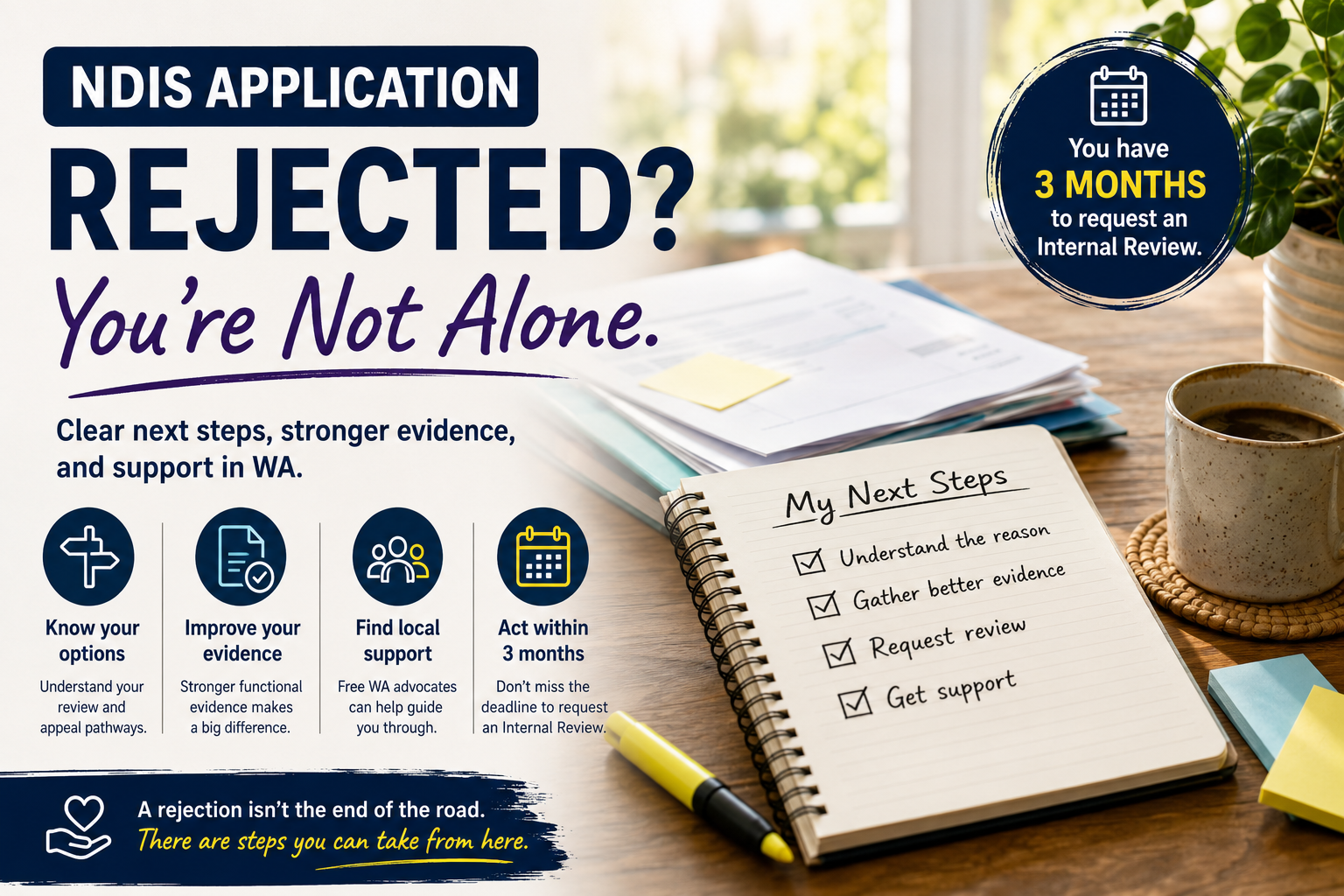
- The review deadline — you have 3 months from the decision date to request an Internal Review. This is strict.
- The exact reason for rejection — usually in a paragraph or two referring to a section of the NDIS Act. If the wording feels vague or impossible to interpret, that’s not your imagination.
If the letter is unclear, you can call the NDIS on 1800 800 110 and ask them to explain it in plain English. That’s a normal request and they handle it routinely. Take notes if you can — it helps later.
What to do in the next 48 hours
If you’re feeling overwhelmed, narrow your focus to these five steps. You don’t have to do anything beyond this list right now.
- Save the rejection letter somewhere safe — a folder, an email to yourself, or both. You’ll refer to it repeatedly.
- Write down the review deadline and put it in your calendar with a reminder a fortnight before.
- Call the NDIS on 1800 800 110 if any part of the letter is unclear — ask for a plain-English explanation of the specific reason.
- Book a GP or specialist appointment to start gathering stronger functional evidence. Lead times for OT and specialist reports are often 4–8 weeks.
- Contact a free advocacy service (your LAC, or one of the WA organisations listed below) to talk through your options without committing to anything.
That’s it for the first 48 hours. The bigger decisions can wait until you’ve slept on it.
Why NDIS applications get rejected (the real reasons)
Most rejections fall into one of five common buckets. Understanding which one applies to you usually tells you exactly what to fix.
- The disability evidence wasn’t specific enough. The medical report named the diagnosis but didn’t clearly describe how it affects day-to-day life. This is the single most common reason.
- Evidence came from the wrong type of professional. Some conditions need specialist evidence: a psychiatrist or clinical psychologist for psychosocial disability, a paediatrician for early childhood, an OT for functional capacity. A GP letter alone often isn’t enough.
- The condition was deemed “episodic” rather than lifelong. Common for mental health conditions, chronic fatigue, and other fluctuating conditions where someone has good weeks and hard weeks.
- “Other systems should fund this.” The NDIA sometimes argues that the health, aged care, or education system should cover the support instead of the NDIS. For example, the NDIA may argue that certain therapy supports belong under the health system, or that classroom-based assistance is the education department’s responsibility.
- Age-related rather than disability-related. The NDIS doesn’t cover age-related decline — people becoming eligible for aged care services usually go through My Aged Care instead.
Many of these reasons are fixable with better evidence — they’re not a verdict on whether you actually need support.
The single most important thing to understand: the NDIS assesses functional impact, not just diagnosis. Two people with the same condition can be assessed very differently depending on how well their evidence describes the everyday reality of living with it.
Your three options after a rejection
You have three formal paths forward. Most people only need one or two of these pathways.
Option 1: Request an Internal Review
- Free, done by a different NDIA officer than the one who made the original decision.
- Must be requested within 3 months of the decision date.
- You can submit new evidence as part of the review.
- Typically takes 60–90 days for a decision.
Option 2: Submit a new Access Request
- Useful if your situation has changed, or if you can gather significantly stronger evidence than the first time.
- No time limit — you can do this any time after a rejection.
- Treated as a fresh decision, not a continuation of the old one.
- In some cases, people choose to reapply with strong new evidence instead of waiting for a review outcome.
Option 3: Appeal to the ART (Administrative Review Tribunal)
- The ART replaced the AAT on 14 October 2024 — same role, new name, similar process.
- Only available after an internal review has confirmed the rejection.
- Must be lodged within 28 days of the internal review decision.
- Free and independent of the NDIA.
- Most people use this only if internal review hasn’t worked.
The right path depends on your circumstances. If you’re not sure, talk to an advocacy service before committing — most can advise for free.
How to strengthen your evidence for a review or reapplication
This is where most of the practical work happens. If the original rejection was about evidence — and most are — these are the changes that make the biggest difference.
Get specific, functional evidence
NDIS decision-makers don’t just want to know what the condition is — they want to know what it stops you doing. Specific examples, real routines, and practical impacts are far more useful than general descriptions.
| Weak evidence | Strong evidence |
|---|---|
| “John has autism.” | “John requires daily prompting for personal care, cannot travel independently on public transport, and experiences sensory overload in unfamiliar environments approximately 3–4 times per week.” |
| “Maria has depression.” | “Maria has not maintained employment in 18 months, requires daily medication prompts from family, and is unable to leave the house unaccompanied 4–5 days per week.” |
| “David has a back injury.” | “David is unable to stand for more than 10 minutes, cannot lift items over 2kg without support, and requires assistance with showering and dressing each morning.” |
Use the right professional for the condition
- Psychosocial disability → psychiatrist or clinical psychologist
- Physical disability → relevant specialist plus an Occupational Therapist
- Intellectual disability → psychologist with formal cognitive testing
- Autism → diagnosis from a multi-disciplinary team, paediatrician, or psychiatrist
Add an Occupational Therapy assessment
Often the single biggest improvement to a weak application. OTs are specifically trained to document functional impact — exactly the kind of evidence the NDIS is looking for. Ask your GP, support coordinator, or LAC about a referral pathway.
Show “permanent and significant”
The NDIS uses this exact phrase. Your evidence needs to demonstrate both — particularly for conditions that fluctuate. Make sure your medical evidence explicitly addresses the long-term, ongoing nature of the impact.
Include a personal statement — and bring in the people around you
A one-page letter in your own words about what daily life actually looks like. It doesn’t need to be polished — it needs to be honest. It humanises a file that can otherwise feel like a stack of clinical reports.
Statements from carers, family members, or support workers can also help demonstrate what daily support actually looks like. Many applicants underreport or minimise their own needs simply because they’ve adapted to them — a partner, parent, or worker often notices things the applicant has stopped noticing.
Where to get help in Western Australia
You don’t have to do this alone, and most of the best help is free.
- Local Area Coordinators (LACs) — in WA, Mission Australia runs LAC services for most regions. They can help you understand the rejection, gather evidence, and submit a review at no cost.
- NDIS Appeals Support Program — a federally funded program that provides free, independent advocates specifically for ART (formerly AAT) appeals.
- Disability advocacy services in WA:
- People With disabilities WA (PWdWA) — general disability advocacy.
- Developmental Disability WA — for intellectual and developmental disability.
- Mental Health Law Centre WA — specialist legal advocacy for psychosocial appeals.
- Some disability providers or coordinators may offer an introductory conversation about what your evidence needs to look like, even before you have a funded plan.
Most of these services cover the Perth metro area (Joondalup, Osborne Park, Midland, Rockingham, Mandurah) and have regional WA coverage where possible.
If speaking with the NDIA or sitting through a long meeting feels overwhelming, it’s completely okay to bring a family member, advocate, or support person into those conversations with you. Many people freeze, forget details, or feel intimidated during bureaucratic calls — having someone alongside you to take notes or step in is a normal, accepted thing to do.
Mistakes to avoid
A few things that quietly trip people up:
- Don’t ignore the 3-month deadline. It’s strict, and a missed deadline usually means starting over with a new Access Request.
- Don’t submit the same evidence again for an internal review and expect a different result. Reviews look at new or strengthened material.
- Don’t try to argue your way to a different outcome over the phone. Get everything through proper written channels so it’s documented.
- Don’t go it alone if the evidence picture is complex. Advocates and OTs make a measurable difference, and most are free.
- Don’t pay private consultants thousands of dollars upfront on a promise of guaranteed approval. Nobody can guarantee an NDIS decision — and most of the genuinely useful help is free or NDIS-funded.
- Don’t assume the ART is your only option. Internal review succeeds more often than people expect, particularly when paired with stronger evidence.
What to expect from the timeline
A realistic picture so you can plan your headspace, not just your paperwork.
- Internal review: typically 60–90 days from request.
- Gathering new evidence: allow 4–8 weeks for OT or specialist appointments and reports.
- ART appeal: 6–12 months from application to decision (with conciliation meetings along the way).
- Reapplication with strong new evidence: sometimes faster than a review, with no formal NDIA deadline pressure.
Long silences during a review period are normal and don’t usually mean your application is being ignored — internal reviews involve a full re-examination of your file, which simply takes time. If you’ve heard nothing after 90 days, a polite follow-up call to the NDIS is reasonable.
This isn’t a fast process, but it’s a process that works for thousands of people every year. The wait is hard. But it doesn’t mean the answer is final.
Frequently asked questions
Is an NDIS rejection final?
No. A rejection is the starting point of a review process — not the end. You have three formal options: request an internal review within 3 months, submit a fresh Access Request at any time, or escalate to the Administrative Review Tribunal (ART) after an internal review. Many initially rejected applicants eventually receive an NDIS plan.
How long do I have to appeal an NDIS decision?
You have 3 months from the decision date to request an Internal Review. If the internal review confirms the rejection, you then have 28 days to apply to the Administrative Review Tribunal (ART) — which replaced the AAT on 14 October 2024. Both deadlines are strict.
Can I get help with an NDIS appeal?
Yes — and most of it is free. Local Area Coordinators (Mission Australia in WA), disability advocacy services like PWdWA and Mental Health Law Centre WA, and the federally funded NDIS Appeals Support Program can all help you prepare a review or appeal. Be cautious of private consultants charging thousands of dollars for what advocates often do free.
Does the NDIS reject most first-time applications?
No, but rejections are common enough that it’s well-documented — particularly for psychosocial disability, fluctuating conditions, and applications without OT or specialist evidence. The good news is that many rejections can be resolved with stronger evidence at internal review or reapplication.
Can I reapply after a rejection?
Yes. There’s no waiting period and no limit on the number of Access Requests you can submit. A reapplication with significantly stronger evidence is often a sensible alternative to internal review, particularly if your circumstances have changed since the original application.
What evidence does the NDIS need to approve my application?
The NDIS needs evidence that shows your disability is permanent and significant, and that it substantially reduces your functional capacity in areas like communication, social interaction, learning, mobility, self-care, or self-management. The evidence should describe day-to-day impact in concrete terms — not just name the diagnosis.
Will reapplying affect any other benefits I’m receiving?
No. The NDIS is separate from Centrelink, Medicare, the Disability Support Pension, and state-funded supports. A new NDIS application doesn’t affect those entitlements either way.
Can I still get support while I’m waiting for a review?
Yes, there are options. Speak to your GP about a Mental Health Care Plan or Chronic Disease Management Plan, which can fund a limited number of allied health sessions through Medicare. Community mental health services, state-funded disability supports, and local advocacy organisations can often provide interim help. Don’t wait until the review is decided to ask for support — most services can start working with you straight away.
A gentle next step
If you’re sitting with a rejection letter and not sure where to start, you don’t have to figure it out alone. We’re happy to have a no-pressure conversation about what your situation looks like, what evidence might strengthen a review, and which local supports could help — whether or not we end up being part of your plan.
You can get in touch with our team for a friendly chat, learn more about the NDIS application process, or read about our NDIS services in Perth and WA.
A rejection feels like a closed door. In most cases, it isn’t. The next step is just understanding which option is right for you — and you’ve already started by reading this.
Reviewed by the Innovative Care coordination team — Perth-based coordinators and senior support staff with hands-on experience supporting NDIS participants across applications, plan reviews, advocacy, community participation, and in-home support services in Western Australia. Last reviewed: 28 May 2026.