<p>For many people living with a psychosocial disability, the hardest part isn't just managing symptoms — it's managing everyday life around them. Appointments, routines, relationships, paperwork, the constant low-level admin of keeping things together. It adds up.</p>
<p>If that sounds familiar, there is an NDIS support designed specifically for this: <strong>Psychosocial Recovery Coaching</strong>. Most participants we speak to in Perth either haven't heard of it, or aren't sure if it's meant for them. This guide explains what it is, who it's for, and what it actually looks like week to week — in plain English, without the jargon.</p>
<hr>
<h2>What is Psychosocial Recovery Coaching?</h2>
<p>Psychosocial Recovery Coaching is an NDIS-funded support for people whose lives are significantly affected by a mental health condition. A recovery coach works with you over time to help you build the routines, confidence, and supports that make daily life feel more manageable.</p>
<p>It was added as a dedicated NDIS support type in 2020 to recognise the unique needs of people living with mental health–related disability.</p>
<p>One thing worth clearing up early: <strong>recovery coaches aren't emergency mental health services or clinical therapists</strong>. They sit alongside those services rather than replacing them. The focus is on the day-to-day work of helping everyday life feel more manageable and less overwhelming over time — not crisis response or therapy.</p>
<hr>
<h2>Who is it for?</h2>
<h3>First, what does "psychosocial disability" actually mean?</h3>
<p>A psychosocial disability is when a mental health condition significantly affects your ability to participate in everyday life over the long term. It's not about diagnosis alone — it's about the ongoing functional impact.</p>
<p>Common examples include schizophrenia, bipolar disorder, severe depression, PTSD, and anxiety disorders, when they create lasting day-to-day challenges. Two people with the same diagnosis can have very different levels of psychosocial disability — the NDIS looks at how it affects your life, not just the label.</p>
<p>A lot of people feel overwhelmed by this part of the process at first. That's normal — it's a system designed for paperwork, not for the people moving through it.</p>
<h3>Signs Recovery Coaching might be a good fit</h3>
<p>Recovery Coaching is generally a good fit if you (or someone you care for):</p>
<ul>
<li>Find it hard to keep up with daily routines like sleep, meals, or hygiene.</li>
<li>Miss appointments, forget medications, or struggle to navigate the system.</li>
<li>Feel isolated or disconnected from community.</li>
<li>Rely heavily on family to keep things on track — and the family is burning out.</li>
<li>Have had repeated hospital admissions or contact with crisis services.</li>
<li>Want to work toward bigger goals (study, work, independence) but don't know where to start.</li>
</ul>
<h3>How it gets into your NDIS plan</h3>
<p>Recovery Coaching is funded under the <strong>Improved Daily Living</strong> category of your plan, as a specific line item called <em>Psychosocial Recovery Coach</em>. If you can't see it in your current plan, you can request it at your next plan review — or ask for an early review if your circumstances have changed.</p>
<hr>
<h2>What does a Recovery Coach actually do?</h2>
<p>This is the part most people want to understand, because "recovery coaching" can sound abstract until you see what it looks like in practice.</p>
<p>A recovery coach helps you do the practical, sometimes invisible work of building a life that feels more stable. Unlike a support worker, <strong>a recovery coach focuses less on doing tasks for you and more on helping you build confidence, routines, and long-term capacity</strong>. The goal is independence over time, not ongoing dependency.</p>
<p>The role isn't to take over your life — it's to help you build the confidence and structure to shape it yourself, at your own pace, around the goals that matter to you.</p>
<h3>In a typical week, your coach might</h3>
<ul>
<li>Sit down with you to plan the week — meals, appointments, energy levels, what's realistic.</li>
<li>Help you prepare for a GP, psychiatrist, or specialist appointment (and debrief after).</li>
<li>Coach you through a setback — a hard week, a relapse, a missed plan — without judgement.</li>
<li>Help you connect with other NDIS supports, mainstream services, or community groups.</li>
<li>Work with your family or carers so they understand how to best support you.</li>
<li>Help you build small skills: cooking, budgeting, using public transport, managing medication.</li>
<li>Notice early signs you're slipping, and help you act before it becomes a crisis.</li>
</ul>
<h3>What sessions actually feel like</h3>
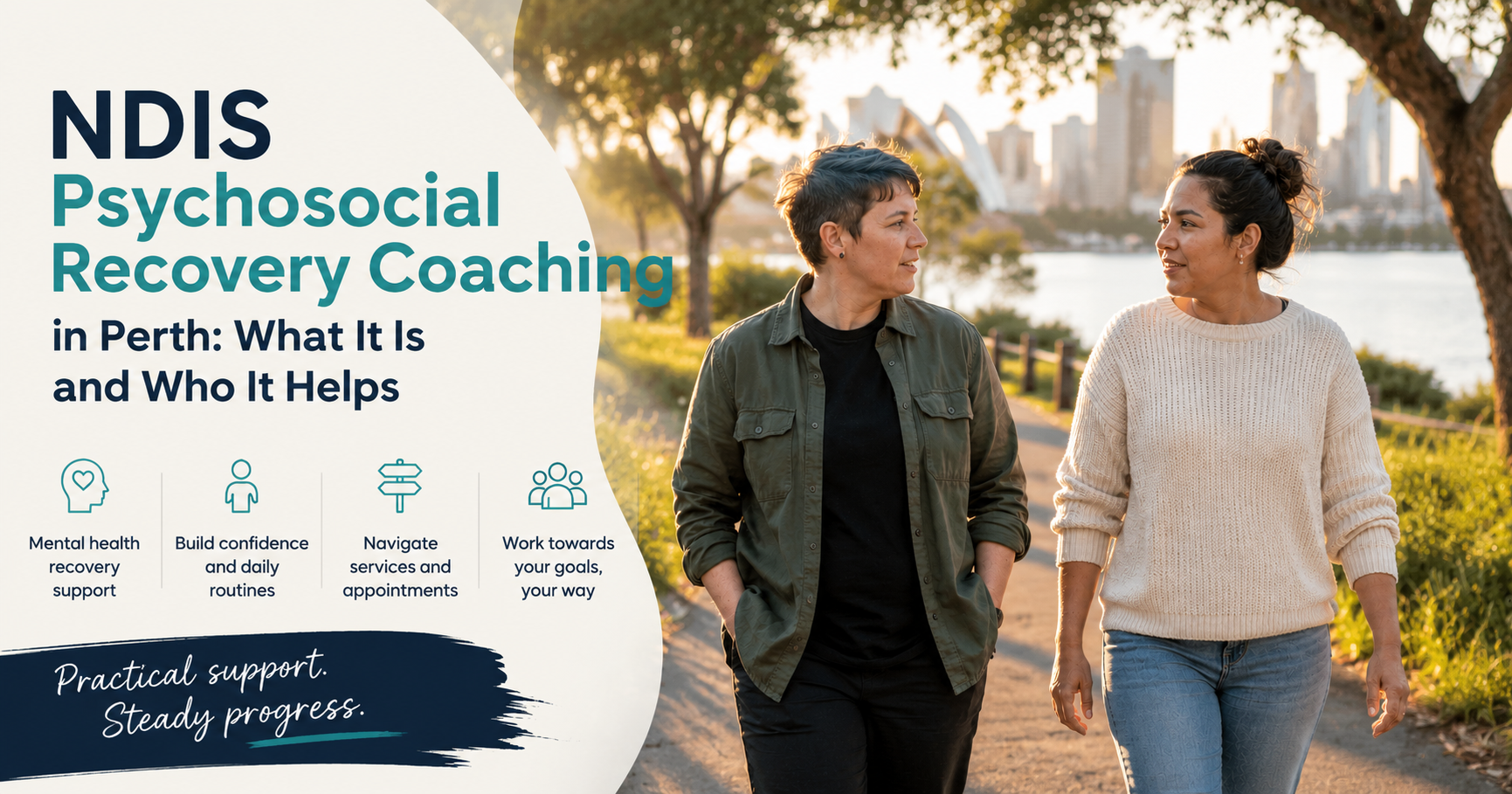
<p>Sessions are usually informal and practical. Some participants meet over coffee, during a walk, in a community space, or at home. The focus is often on small, achievable steps — building confidence, sorting out a routine, planning the week — not formal therapy.</p>
<p>You set the pace, and a good coach meets you where you are. No clipboards required. It's also completely normal if it takes time to feel comfortable with a coach — especially if you've had difficult experiences with services in the past. Trust is built slowly, and that's expected.</p>
<blockquote class="wp-block-quote recovery-pull-quote">
<p><strong>Recovery isn't always a straight line, and setbacks don't mean failure.</strong> Coaching is built around that reality.</p>
</blockquote>
<hr>
<h2>How does it actually help?</h2>
<p>The honest answer is: it usually helps slowly, in ways that don't always feel dramatic at the time.</p>
<p>Over months of consistent coaching, the kinds of changes people commonly experience include:</p>
<ul>
<li><strong>More confidence</strong> in managing your own NDIS plan and daily life.</li>
<li><strong>Fewer crisis points</strong> — because problems get caught earlier.</li>
<li><strong>Stronger family relationships</strong> — coaches can take some of the load off family members who've been doing everything.</li>
<li><strong>Steady progress</strong> toward goals like part-time work, study, volunteering, or just having more good days than hard ones.</li>
</ul>
<p>Imagine someone in Perth's northern suburbs who, six months ago, hadn't left the house unaccompanied in over a year. With weekly coaching, they've started taking the bus to a community art class on Wednesdays. That's not a transformation — it's a foothold. And footholds are how recovery actually works.</p>
<hr>
<h2>Recovery Coach vs Support Coordinator vs Psychologist: what's the difference?</h2>
<p>This is the single biggest confusion point we hear. All three roles can appear in an NDIS plan, all three involve supporting you — but they do very different things.</p>
<figure class="wp-block-table"><table>
<thead>
<tr>
<th></th>
<th><strong>Recovery Coach</strong></th>
<th><strong>Support Coordinator</strong></th>
<th><strong>Psychologist</strong></th>
</tr>
</thead>
<tbody>
<tr>
<td><strong>Focus</strong></td>
<td>Mental-health recovery + daily life skills</td>
<td>Connecting and coordinating your NDIS supports</td>
<td>Clinical mental health treatment</td>
</tr>
<tr>
<td><strong>Best for</strong></td>
<td>People with psychosocial disability working on long-term capacity</td>
<td>Anyone needing help understanding and using their plan</td>
<td>Therapy, diagnosis, clinical care</td>
</tr>
<tr>
<td><strong>Funded under</strong></td>
<td>Improved Daily Living (Recovery Coach line item)</td>
<td>Capacity Building (Support Coordination)</td>
<td>Improved Daily Living (Therapeutic Supports)</td>
</tr>
<tr>
<td><strong>Typical contact</strong></td>
<td>Weekly or fortnightly, ongoing</td>
<td>As needed, based on plan complexity</td>
<td>Scheduled clinical sessions</td>
</tr>
</tbody>
</table></figure>
<p>You can have more than one of these in your plan — they work well together. A recovery coach is often the person who keeps the bigger picture connected.</p>
<hr>
<h2>How to access Psychosocial Recovery Coaching through your NDIS plan</h2>
<ol>
<li><strong>Check your current plan</strong> for the line item "Psychosocial Recovery Coach" under Improved Daily Living.</li>
<li><strong>If it's not there</strong>, raise it at your next plan review — or request an early review through your LAC, support coordinator, or directly with the NDIS.</li>
<li><strong>Choose a registered provider</strong> in your area. (Our <a href="https://innovativecarewa.com.au/best-ndis-providers-perth/">guide to choosing an NDIS provider</a> walks through what to look for.)</li>
<li><strong>Meet a coach first</strong> — most providers offer a no-obligation chat or intro session so you can see if the fit feels right.</li>
<li><strong>Start sessions</strong> — usually weekly or fortnightly, often a mix of in-person and check-in calls.</li>
</ol>
<p>If you're not sure how the funding works alongside your other supports, our breakdown of <a href="https://innovativecarewa.com.au/understanding-your-ndis-budget/">how NDIS funding categories work</a> explains the bigger picture.</p>
<hr>
<h2>What to look for in a great Recovery Coach</h2>
<p>Not every coach will be the right fit, and that's normal. When you're meeting potential coaches, look for:</p>
<ul>
<li><strong>Lived experience</strong> — either personally or through close family. The NDIS specifically recognises lived experience as a core part of the recovery coach role.</li>
<li><strong>Mental health–specific training</strong> and an understanding of recovery-oriented practice.</li>
<li><strong>Local knowledge</strong> — they should know the Perth services, GP networks, community groups, and pathways available where you live. A coach who genuinely knows the local landscape will save you weeks of trial and error.</li>
<li><strong>Cultural and linguistic fit</strong> — especially important for Aboriginal participants, CALD communities, and LGBTQIA+ participants.</li>
<li><strong>Someone you actually feel comfortable talking to.</strong> This is the most important one. Skills can be taught; trust can't be rushed.</li>
</ul>
<hr>
<h2>Psychosocial Recovery Coaching across Perth and Western Australia</h2>
<p>Psychosocial recovery coaching is available across the Perth metropolitan area — including <strong>Joondalup, Osborne Park, Midland, Rockingham, Mandurah</strong>, and the surrounding northern and southern suburbs. In-person sessions are typically the default wherever possible, because the relational, walk-and-talk style of recovery coaching works best face to face. Local coaches also tend to know the practical Perth-specific details that make a difference — community mental health pathways, GP networks, transport routes, and where the genuine service gaps sit.</p>
<p>For participants outside the metro area, virtual coaching is available where appropriate and depending on participant needs — particularly for check-ins, planning sessions, and ongoing support between in-person visits.</p>
<p>Innovative Care's recovery coaching team is locally based in Western Australia and trained in recovery-oriented mental health support, working with participants of all ages, backgrounds, and stages of their recovery journey.</p>
<hr>
<h2>Frequently asked questions</h2>
<h3>Is Psychosocial Recovery Coaching the same as counselling?</h3>
<p>No. Counselling and therapy focus on the clinical side of mental health — exploring thoughts, feelings, and behaviours in a structured therapeutic setting. Recovery coaching is practical and life-focused: building routines, connecting supports, and developing day-to-day capacity. The two work very well together, but they're different services.</p>
<h3>Do I need a formal mental health diagnosis to access Recovery Coaching?</h3>
<p>You need to meet the NDIS eligibility criteria for psychosocial disability, which usually involves evidence from a treating health professional (GP, psychiatrist, or psychologist). A formal diagnosis often helps, but the NDIS focuses on the functional impact of your condition rather than the diagnosis itself.</p>
<h3>How is a Recovery Coach different from a Support Worker?</h3>
<p>A support worker generally helps you <em>do</em> things — personal care, transport, household tasks, community access. A recovery coach helps you <em>build the capacity</em> to manage those things yourself over time, and to navigate the broader system around your mental health. Many participants benefit from having both.</p>
<h3>Can my family or carers be involved in sessions?</h3>
<p>Yes, where it's helpful and you're comfortable with it. A good recovery coach can work directly with your family, run joint sessions, or help your family understand how to best support you without taking over. This is often one of the most valued parts of coaching for families who've been carrying a lot.</p>
<h3>How many hours of Recovery Coaching does the NDIS typically fund?</h3>
<p>Funding levels vary significantly depending on individual circumstances, goals, and the assessment in your NDIS plan. In practice, most participants meet with their recovery coach weekly or fortnightly, with the cadence adjusted as your needs change. The exact amount is set in your plan and can be reviewed if your situation changes.</p>
<h3>What if my coach isn't the right fit?</h3>
<p>This happens, and it's nothing to feel awkward about. Recovery coaching only works when there's trust, so if the fit isn't right, you can ask to change coaches within the same provider — or move to a different provider altogether. A good provider will support that conversation without making it difficult.</p>
<h3>What if I'm in crisis right now?</h3>
<p>Recovery coaching is not a crisis service. If you or someone you care for is in immediate distress, please contact:</p>
<ul>
<li><strong>Lifeline</strong> — 13 11 14 (24/7)</li>
<li><strong>13YARN</strong> — 13 92 76 (24/7, for Aboriginal and Torres Strait Islander people)</li>
<li><strong>000</strong> — for emergency situations</li>
<li><strong>Mental Health Emergency Response Line (WA)</strong> — 1300 555 788 (metro) / 1800 676 822 (Peel)</li>
</ul>
<p>Once things have stabilised, recovery coaching can be one of the supports that helps reduce how often crises happen in the first place.</p>
<hr>
<h2>A gentle next step</h2>
<p>If you're exploring whether Psychosocial Recovery Coaching might be right for you or someone you care for, we'd be glad to talk through your situation — no pressure, no jargon, no commitment to anything.</p>
<p>You can <a href="https://innovativecarewa.com.au/contact-us/">get in touch with our team</a> for a friendly chat, or learn more about our <a href="https://innovativecarewa.com.au/psychosocial-recovery-coach/">psychosocial recovery coaching</a> service across Perth and WA.</p>
<p>Whatever you decide, you don't have to figure it out alone.</p>
<hr />
<p class="reviewer-block"><em>Reviewed by the <strong>Innovative Care coordination team</strong> — Perth-based coordinators and senior support staff with hands-on experience supporting NDIS participants across community participation, in-home support, respite, Supported Independent Living and support coordination services in Western Australia. Last reviewed: 26 May 2026.</em></p>
<script type="application/ld+json">{"@context": "https://schema.org", "@type": "Article", "mainEntityOfPage": {"@type": "WebPage", "@id": "https://innovativecarewa.com.au/ndis-psychosocial-recovery-coaching-perth/"}, "headline": "NDIS Psychosocial Recovery Coaching in Perth: What It Is and Who It Helps", "description": "A clear, practical guide to NDIS Psychosocial Recovery Coaching in Perth \u2014 what it is, who it's for, what sessions look like, and how to access it through your plan.", "image": ["https://innovativecarewa.com.au/wp-content/uploads/2026/05/ndis-psychosocial-recovery-coaching-perth-hero.png"], "datePublished": "2026-05-26", "dateModified": "2026-05-26", "author": {"@type": "Organization", "name": "Innovative Care Coordination Team", "url": "https://innovativecarewa.com.au/about/"}, "publisher": {"@type": "Organization", "name": "Innovative Care", "logo": {"@type": "ImageObject", "url": "https://innovativecarewa.com.au/wp-content/uploads/logo.png"}}, "articleSection": "NDIS Services", "inLanguage": "en-AU", "about": [{"@type": "Thing", "name": "NDIS Psychosocial Recovery Coaching"}, {"@type": "Thing", "name": "Psychosocial disability"}, {"@type": "Place", "name": "Perth, Western Australia"}], "keywords": "NDIS psychosocial recovery coaching Perth, psychosocial disability, NDIS recovery coach, mental health recovery support NDIS, capacity building support, psychosocial recovery coach Western Australia"}</script>
<script type="application/ld+json">{"@context": "https://schema.org", "@type": "FAQPage", "mainEntity": [{"@type": "Question", "name": "Is Psychosocial Recovery Coaching the same as counselling?", "acceptedAnswer": {"@type": "Answer", "text": "No. Counselling and therapy focus on the clinical side of mental health \u2014 exploring thoughts, feelings, and behaviours in a structured therapeutic setting. Recovery coaching is practical and life-focused: building routines, connecting supports, and developing day-to-day capacity. The two work very well together, but they're different services."}}, {"@type": "Question", "name": "Do I need a formal mental health diagnosis to access Recovery Coaching?", "acceptedAnswer": {"@type": "Answer", "text": "You need to meet the NDIS eligibility criteria for psychosocial disability, which usually involves evidence from a treating health professional (GP, psychiatrist, or psychologist). A formal diagnosis often helps, but the NDIS focuses on the functional impact of your condition rather than the diagnosis itself."}}, {"@type": "Question", "name": "How is a Recovery Coach different from a Support Worker?", "acceptedAnswer": {"@type": "Answer", "text": "A support worker generally helps you do things \u2014 personal care, transport, household tasks, community access. A recovery coach helps you build the capacity to manage those things yourself over time, and to navigate the broader system around your mental health. Many participants benefit from having both."}}, {"@type": "Question", "name": "Can my family or carers be involved in sessions?", "acceptedAnswer": {"@type": "Answer", "text": "Yes, where it's helpful and you're comfortable with it. A good recovery coach can work directly with your family, run joint sessions, or help your family understand how to best support you without taking over. This is often one of the most valued parts of coaching for families who've been carrying a lot."}}, {"@type": "Question", "name": "How many hours of Recovery Coaching does the NDIS typically fund?", "acceptedAnswer": {"@type": "Answer", "text": "Funding levels vary significantly depending on individual circumstances, goals, and the assessment in your NDIS plan. In practice, most participants meet with their recovery coach weekly or fortnightly, with the cadence adjusted as your needs change. The exact amount is set in your plan and can be reviewed if your situation changes."}}, {"@type": "Question", "name": "What if my coach isn't the right fit?", "acceptedAnswer": {"@type": "Answer", "text": "This happens, and it's nothing to feel awkward about. Recovery coaching only works when there's trust, so if the fit isn't right, you can ask to change coaches within the same provider \u2014 or move to a different provider altogether. A good provider will support that conversation without making it difficult."}}, {"@type": "Question", "name": "What if I'm in crisis right now?", "acceptedAnswer": {"@type": "Answer", "text": "Recovery coaching is not a crisis service. If you or someone you care for is in immediate distress, please contact Lifeline on 13 11 14 (24/7), 13YARN on 13 92 76 (24/7, for Aboriginal and Torres Strait Islander people), 000 for emergencies, or the WA Mental Health Emergency Response Line on 1300 555 788 (metro) / 1800 676 822 (Peel). Once things have stabilised, recovery coaching can be one of the supports that helps reduce how often crises happen in the first place."}}]}</script>
<script type="application/ld+json">{"@context": "https://schema.org", "@type": "BreadcrumbList", "itemListElement": [{"@type": "ListItem", "position": 1, "name": "Home", "item": "https://innovativecarewa.com.au/"}, {"@type": "ListItem", "position": 2, "name": "Blog", "item": "https://innovativecarewa.com.au/blog/"}, {"@type": "ListItem", "position": 3, "name": "NDIS Psychosocial Recovery Coaching in Perth", "item": "https://innovativecarewa.com.au/ndis-psychosocial-recovery-coaching-perth/"}]}</script>
NDIS Psychosocial Recovery Coaching in Perth: What It Is and Who It Helps